
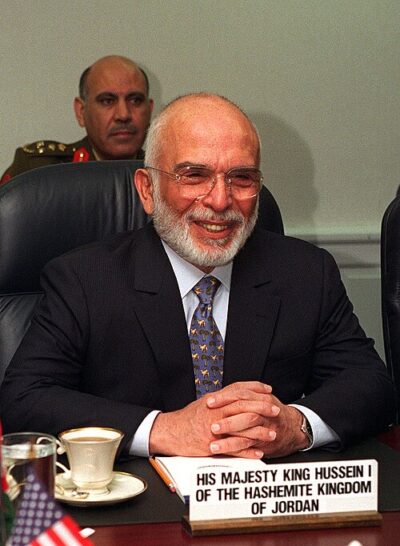
Hussein I of Jordan
Hussein I of Jordan was a King of Jordan from 1952 to 1999. Born November 14, 1935, in Amman. Died February 7, 1999, in Amman. Positions held include King of Jordan (1952–1999). Educated at Harrow School and Royal Military Academy Sandhurst. Awards include Knight of the Order of the Golden Fleece, Honorary Knight Grand Cross of the Order of the Bath and Collar of the Order of Isabella the Catholic.
Facts
61 facts · 2 confirmed by two sources · 8 cited · 51 from one source
Where this comes from
Papalocal keeps its own record. It started from these sources; what each one said is kept here as it was copied, so a change on their side never changes this page by itself. Tap one to read its version.
What Wikidata says · copied November 16, 2026 · revision 2567980120
- Described as
- King of Jordan from 1952 to 1999
- Other names
- Hussein bin Talal -حسين بن طلال - Ḥusayn bin Ṭalāl, Hussein bin Talal, Husein I, Hussein Bin Talal, King Hussein bin Talal
- Born
- November 14, 1935 · 12 references
- Died
- February 7, 1999 · 9 references
- Born in
- Amman · 2 references
- Died in
- Amman · 1 reference
- Buried in
- Raghadan Palace
- Cause of death
- non-Hodgkin lymphoma
- Name at birth
- الحسين بن طلال بن عبد الله بن الحسين بن علي العوني العبدلي القتادي الحسني العلوي الهاشمي القُرشي
- Citizen of
- Emirate of Transjordan (1935–1946); Jordan (1946–1999); Arab Federation (1958)
- Occupation
- monarch; military leader; politician; diplomacy; statesperson; aircraft pilot
- Positions held
- King of Jordan (1952–1999)
- Education
- Harrow School; Royal Military Academy Sandhurst; Victoria College; Islamic Educational College Schools
- Member of
- Hussein I of Jordan and Queen Noor
- Awards
- Knight of the Order of the Golden Fleece (1985) · 1 reference; Honorary Knight Grand Cross of the Order of the Bath (1984) · 1 reference; Collar of the Order of Isabella the Catholic (1977) · 2 references; Order of the Golden Spur (1964); Order of the Crown of the Realm (1965) · 1 reference; Princess of Asturias Award for Concord (1995) · 2 references; Philadelphia Liberty Medal; Ronald Reagan Freedom Award; Royal Victorian Chain (1966); National Order of Merit (1960); Order of the Two Rivers (1953); Grand Order of the Hashimites (1953); Order of Propitious Clouds (1959); Order of the Umayyads (1955); Order of Independence (1978)
- Spouse
- Princess Dina bint Abdul-Hamid Hashem (1955–1957); Princess Muna Al-Hussein (1961–1972); Queen Alia of Jordan (1972–1977); Queen Noor of Jordan (1978–1999)
- Children
- Princess Alia bint Al-Hussein of Jordan; Abdullah II of Jordan · 1 reference; Prince Feisal bin Al-Hussein of Jordan; Princess Aisha bint Al-Hussein of Jordan; Princess Zein bint Al-Hussein of Jordan; Princess Haya bint Al-Hussein of Jordan; Prince Ali bin Al-Hussein of Jordan; Princess Abir Muhaisen; Hamzah bin Al-Hussein; Prince Hashem bin Al-Hussein of Jordan; Princess Iman bint Al-Hussein of Jordan; Princess Raiyah bint Al-Hussein of Jordan
- Father
- Talal I of Jordan · 1 reference
- Mother
- Zein al-Sharaf Talal
- Siblings
- Princess Basma bint Talal of Jordan; Prince Muhammad bin Talal of Jordan; Prince El Hassan bin Talal of Jordan
- Religion
- Sunni Islam
- Military branch
- Jordanian Armed Forces
- Military rank
- army general
- Wikipedias with a page
- 80
Wikidata item Q146906 (wikidata.org/wiki/Q146906), public domain (CC0). Copied November 16, 2026.
What Wikipedia says · copied November 16, 2026 · revision 1385839092
Hussein (né Hussein bin Talal; Arabic: الحسين بن طلال; 14 November 1935 – 7 February 1999) was King of Jordan from 1952 until his death in 1999. A member of the Hashemite dynasty, he is regarded as a 40th-generation descendant of the Islamic prophet Muhammad.
Hussein was born in Amman as the eldest child of Talal bin Abdullah and Zein al-Sharaf bint Jamil. Talal was at that time the heir to his own father, King Abdullah I. Hussein began his schooling in Amman, continuing his education abroad. After Talal became king in 1951, Hussein was named heir apparent. The Jordanian Parliament forced Talal to abdicate a year later due to his mental illness, and a regency council was appointed until Hussein came of age. He was enthroned at the age of 17 in 1953. Hussein was married four separate times and fathered eleven children.
Hussein, a constitutional monarch, started his rule by allowing the formation of the only democratically elected government in Jordan's history in 1956, which he forced to resign a few months later, declaring martial law and banning political parties. Under Hussein, Jordan fought three wars with Israel, including the 1967 Six-Day War, which ended in Jordan's loss of the West Bank. In 1970, Hussein expelled Palestinian militants from Jordan in what became known as Black September. The King renounced Jordan's ties to the West Bank in 1988 after the Palestine Liberation Organization was recognized internationally as the sole representative of the Palestinians. He lifted martial law and reintroduced elections in 1989 when riots over price hikes spread in southern Jordan. In 1994 he became the second Arab head of state to sign a peace treaty with Israel.
At the time of Hussein's accession in 1953, Jordan was a young nation and controlled the West Bank. The country had few natural resources, and a large Palestinian refugee population as a result of the 1948 Palestine War. Hussein led his country through four turbulent decades of the Arab–Israeli conflict and the Cold War, successfully balancing pressures from Arab nationalists, Islamists, the Soviet Union, Western countries, and Israel, transforming Jordan by the end of his 46-year reign into a stable modern state. After 1967 he engaged in efforts to solve the Israeli–Palestinian conflict. He acted as a conciliatory intermediate between various Middle Eastern rivals, and came to be seen as the region's peacemaker. He was revered for pardoning political dissidents and opponents, and giving them senior posts in the government. Hussein, who survived dozens of assassination attempts and plots to overthrow him, was the region's longest-reigning leader. He died at the age of 63 from cancer in 1999 and was succeeded by his eldest son, Abdullah II.
- Born, in its opening lines
- November 14, 1935
- Died, in its opening lines
- February 7, 1999
From the Wikipedia article “Hussein of Jordan” (en.wikipedia.org/wiki/Hussein_of_Jordan), by its contributors, under CC BY-SA 4.0 (creativecommons.org/licenses/by-sa/4.0/). Copied November 16, 2026; not changed.
Confirmed Two sources agree. Cited One source, and it names where it got it. One source One source, without a reference of its own. Sources disagree The sources disagree. We show the best-supported value and keep theirs below.
