
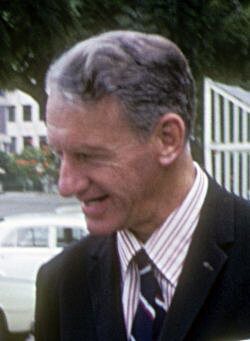
Ian Douglas Smith
Ian Douglas Smith was a Prime Minister of Rhodesia. Born April 8, 1919, in Shurugwi. Died November 20, 2007, in Cape Town. Positions held include Prime Minister of Rhodesia (1964–1979) and Member of the National Assembly of Zimbabwe. Educated at Rhodes University and Chaplin High School.
Facts
26 facts · 2 confirmed by two sources · 4 cited · 20 from one source
Where this comes from
Papalocal keeps its own record. It started from these sources; what each one said is kept here as it was copied, so a change on their side never changes this page by itself. Tap one to read its version.
What Wikidata says · copied November 16, 2026 · revision 2562772387
- Described as
- Prime Minister of Rhodesia (1919–2007)
- Born
- April 8, 1919 · 9 references
- Died
- November 20, 2007 · 9 references
- Born in
- Shurugwi
- Died in
- Cape Town · 1 reference
- Cause of death
- cerebrovascular disease
- Citizen of
- United Kingdom; Rhodesia; Zimbabwe
- Occupation
- politician · 1 reference; farmer; head of government · 1 reference
- Positions held
- Prime Minister of Rhodesia (1964–1979); Member of the National Assembly of Zimbabwe
- Political party
- Southern Rhodesia Liberal Party (1948–1953); United Federal Party (1953–1961); Rhodesian Front (1963–1980); Republican Front (1980–1987)
- Education
- Rhodes University; Chaplin High School
- Field
- agriculture; politics · 1 reference
- Spouse
- Janet Smith
- Children
- Alec Smith
- Religion
- Presbyterianism
- Military branch
- Royal Air Force
- Military rank
- flight lieutenant
- Wikipedias with a page
- 55
Wikidata item Q313424 (wikidata.org/wiki/Q313424), public domain (CC0). Copied November 16, 2026.
What Wikipedia says · copied November 16, 2026 · revision 1384673606
Ian Douglas Smith (8 April 1919 – 20 November 2007) was a Rhodesian and Zimbabwean politician, farmer and former Royal Air Force fighter pilot who served as Prime Minister of Rhodesia from 1964 to 1979. As leader of the Rhodesian Front, he headed a white-minority government that resisted the introduction of majority rule in Southern Rhodesia. On 11 November 1965, his government issued a unilateral declaration of independence (UDI) from the United Kingdom. The declaration was not internationally recognised, and Smith's government subsequently faced United Nations economic sanctions and an increasingly protracted conflict with African nationalist movements.
Born in Selukwe (now Shurugwi), Southern Rhodesia, to British settler parents, Smith served in the Royal Air Force during the Second World War. After the war, he completed his studies at Rhodes University, became a farmer and was elected to the Southern Rhodesian parliament in 1948. Initially a member of the Liberal Party, he later joined the United Federal Party before co-founding the Rhodesian Front in 1962. He became deputy prime minister under Winston Field that year and succeeded Field as prime minister in April 1964.
Smith's government sought independence without accepting British conditions for progress towards majority rule. Following UDI, Rhodesia remained governed by a white minority, although black Africans constituted the overwhelming majority of its population. Electoral qualifications and the allocation of parliamentary seats restricted African political representation. In 1970, Smith's government declared Rhodesia a republic, but the country remained internationally isolated. During his premiership, the Rhodesian Bush War intensified as the Rhodesian security forces fought nationalist guerrilla movements, principally the Zimbabwe African National Union (ZANU) and the Zimbabwe African People's Union (ZAPU). By the late 1970s, military pressure, economic sanctions and changes in the regional political situation had weakened the government's position.
In 1978, Smith negotiated the Internal Settlement with several black nationalist leaders. The agreement led to the establishment of Zimbabwe Rhodesia in 1979, with Abel Muzorewa as prime minister, but excluded ZANU and ZAPU and failed to secure international recognition or end the war. Smith subsequently took part in the Lancaster House negotiations, which led to British-supervised elections and Zimbabwe's internationally recognised independence in April 1980. He remained a member of the Zimbabwean parliament until 1987 and continued to criticise the government of Robert Mugabe. Smith died in Cape Town, South Africa, in 2007. His political legacy remains associated with UDI, the maintenance of white-minority rule and the conflict that preceded Zimbabwean independence.
- Born, in its opening lines
- April 8, 1919
- Died, in its opening lines
- November 20, 2007
From the Wikipedia article “Ian Smith” (en.wikipedia.org/wiki/Ian_Smith), by its contributors, under CC BY-SA 4.0 (creativecommons.org/licenses/by-sa/4.0/). Copied November 16, 2026; not changed.
Confirmed Two sources agree. Cited One source, and it names where it got it. One source One source, without a reference of its own. Sources disagree The sources disagree. We show the best-supported value and keep theirs below.
