
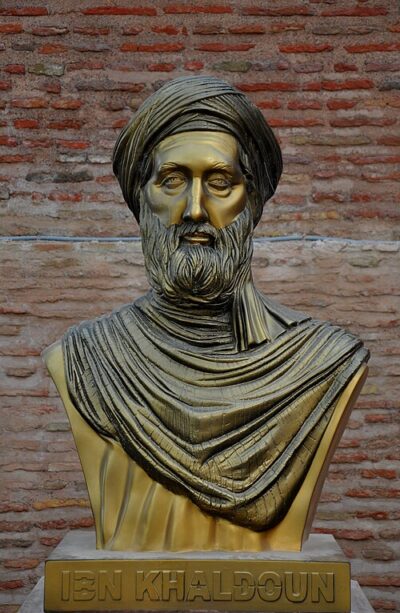
Ibn Khaldun
Ibn Khaldun was a historiographer and historian. Born May 27, 1332, in Tunis. Died March 17, 1406, in Cairo. Known for Muqaddimah, Kitab al-Ibar and Lubābu l-Muhassal. Educated at Ez-Zitouna University.
Facts
24 facts · 2 confirmed by two sources · 4 cited · 18 from one source
What’s different
- Died: we show March 17, 1406 (Confirmed). Wikidata also lists 1406
Where this comes from
Papalocal keeps its own record. It started from these sources; what each one said is kept here as it was copied, so a change on their side never changes this page by itself. Tap one to read its version.
What Wikidata says · copied November 16, 2026 · revision 2567388663
- Described as
- historiographer and historian
- Other names
- Abu Zajd ʻAbdarraḥmân ibn Muḥammad ibn Muḥammad Ibn Haldûn, عبد الرحمٰن بن مُحمَّد بن خلدون الحضرمي
- Born
- May 27, 1332 · 2 references
- Died
- March 17, 1406 · 1 reference; 1406 · 1 reference
- Born in
- Tunis · 2 references
- Died in
- Cairo · 1 reference
- Occupation
- anthropologist; historian · 2 references; judge; autobiographer; sociologist; economist; philosopher · 2 references; politician · 1 reference
- Education
- Ez-Zitouna University
- Known for
- Muqaddimah; Kitab al-Ibar (1363); Lubābu l-Muhassal
- Field
- economics · 1 reference; sociology; philosophy; anthropology; politician; economy · 1 reference
- Siblings
- Yahya Ibn Khaldun
- Religion
- Islam
- Wikipedias with a page
- 167
Wikidata item Q9294 (wikidata.org/wiki/Q9294), public domain (CC0). Copied November 16, 2026.
What Wikipedia says · copied November 16, 2026 · revision 1385110013
Ibn Khaldūn (27 May 1332 – 17 March 1406, 732–808 AH) was an Arab Tunisian scholar, historian, philosopher, and sociologist. He is widely acknowledged to be one of the greatest social scientists of the Middle Ages, and is considered by a number of scholars to be a major forerunner of historiography, sociology, economics, and demography studies.
His best-known book is the Muqaddimah or Prolegomena ("Introduction"), which he wrote in six months as he states in his autobiography. It later influenced 17th-century and 19th-century Ottoman historians such as Kâtip Çelebi, Mustafa Naima and Ahmed Cevdet Pasha, who used its theories to analyze the growth and decline of the Ottoman Empire. Ibn Khaldun interacted with Tamerlane, the founder of the Timurid Empire.
He has been called one of the most prominent Muslim and Arab scholars and historians. Recently, Ibn Khaldun's works have been compared with those of influential European philosophers such as Niccolò Machiavelli, Giambattista Vico, David Hume, G. W. F. Hegel, Karl Marx, and Auguste Comte as well as the economists David Ricardo and Adam Smith, suggesting that their ideas found precedent (although not direct influence) in his. He has also been influential on certain modern Islamic thinkers (e.g. those of the traditionalist school).
- Born, in its opening lines
- May 27, 1332
- Died, in its opening lines
- March 17, 1406
From the Wikipedia article “Ibn Khaldun” (en.wikipedia.org/wiki/Ibn_Khaldun), by its contributors, under CC BY-SA 4.0 (creativecommons.org/licenses/by-sa/4.0/). Copied November 16, 2026; not changed.
Confirmed Two sources agree. Cited One source, and it names where it got it. One source One source, without a reference of its own. Sources disagree The sources disagree. We show the best-supported value and keep theirs below.
