
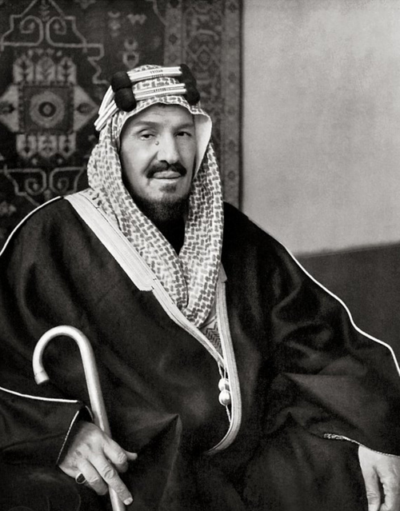
Ibn Saud
Ibn Saud was a King of Saudi Arabia from 1932 to 1953. Born January 15, 1876, in Riyadh. Died November 9, 1953, in Ta'if. Positions held include King of Saudi Arabia (1932–1953), Wizarate of War (1901–1921) and Prime Minister of Saudi Arabia (1932–1953). Known for Third Saudi State. Awards include Knight Commander of the Order of the Bath, Legion of Merit and Knight Grand Cross in the Order of the Netherlands Lion.
Facts
57 facts · 2 confirmed by two sources · 4 cited · 51 from one source
What’s different
- Born: we show January 15, 1876 (Confirmed). Wikidata also lists 1876
Where this comes from
Papalocal keeps its own record. It started from these sources; what each one said is kept here as it was copied, so a change on their side never changes this page by itself. Tap one to read its version.
What Wikidata says · copied November 16, 2026 · revision 2564271181
- Described as
- King of Saudi Arabia from 1932 to 1953
- Other names
- Abdulaziz bin Abdul Rahman Al Saud, ʻAbd al-ʻAzīz ibn ʻAbd al-Raḥmān ibn Faisal Āl Saʻūd,, Abdulaziz, Abdulaziz ibn Abdul Rahman ibn Faisal ibn Turki ibn Abdullah ibn Muhammad Al Saud, King Abdulaziz bin Abdul Rahman, King Abdulaziz of Saudi Arabia
- Born
- January 15, 1876 · 1 reference; 1876 · 1 reference
- Died
- November 9, 1953 · 1 reference
- Born in
- Riyadh · 1 reference
- Died in
- Ta'if · 1 reference
- Buried in
- Al Oud cemetery · 1 reference
- Cause of death
- myocardial infarction
- Citizen of
- Saudi Arabia
- Occupation
- statesperson; monarch; politician; military personnel; king · 1 reference
- Positions held
- King of Saudi Arabia (1932–1953) · 2 references; Wizarate of War (1901–1921); Prime Minister of Saudi Arabia (1932–1953) · 1 reference
- Sport
- equestrian sport
- Known for
- Third Saudi State
- Awards
- Knight Commander of the Order of the Bath; Legion of Merit; Knight Grand Cross in the Order of the Netherlands Lion (1936) · 1 reference; Cross of Military Merit · 1 reference
- Field
- politics
- Spouse
- Fahda bint Asi Al Shuraim · 1 reference; Hassa bint Ahmed Al Sudairi · 1 reference; Al Jawhara bint Musaed Al Jiluwi; Sharifa bint Saqr Al Fajri (1894); Wadhah Bint Muhammad; Sarah bint Abdullah bin Faisal
- Children
- Saud of Saudi Arabia; King Faisal bin Abdulaziz Al Saud; Khalid of Saudi Arabia; Fahd bin Abdulaziz Al Saud; Abdullah of Saudi Arabia; Salman bin Abdulaziz Al Saud · 1 reference; Turki I bin Abdul; Muhammad bin Abdulaziz Al Saud; Nasser bin Abdulaziz; Saad bin Abdulaziz; Mansour bin Abdulaziz Al Saud; Nayef bin Abdul-Aziz Al Saud
- Father
- Abdul Rahman bin Faisal
- Mother
- Sarah Al Sudairi
- Siblings
- Noura bint Abdul Rahman Al Saud; Muhammad bin Abdul-Rahman; Abdullah bin Abdul-Rahman · 1 reference; Musaid bin Abdul Rahman; Sa'ad bin Abdul-Rahman; Faisal bin Abdul Rahman bin Faisal bin Turki Al Saud; Fahd bin Abdul Rahman bin Faisal Al Saud; Khalid bin Abdul Rahman bin Faisal bin Turki Al Saud; Saud bin Abdul Rahman bin Faisal Al Saud; Saad II bin Abdul Rahman bin Faisal Al Saud
- Religion
- Islam · 1 reference
- Military branch
- Saudi Arabian Armed Forces (1901–1933)
- Military rank
- commander-in-chief (1921–1953); wazir (1901–1921)
- Lived in
- Royal Court (1902–1953)
- Wikipedias with a page
- 95
Wikidata item Q151509 (wikidata.org/wiki/Q151509), public domain (CC0). Copied November 16, 2026.
What Wikipedia says · copied November 16, 2026 · revision 1383724046
Abdulaziz bin Abdul Rahman bin Faisal Al Saud (Arabic: عَبْدُ الْعَزِيزِ بْنُ عَبْدِ الرَّحْمَٰنِ بْنِ فَيْصَلٍ آلِ سُعُود, romanized: ʿAbd al-ʿAzīz ibn ʿAbd al-Raḥmān ibn Fayṣal Āl Saʿūd; 15 January 1876 – 9 November 1953), known in the Western world as Ibn Saud (Arabic: ابن سعود; Ibn Suʿūd), and known with his kunya Abu Turki (Arabic: أَبُو تُرْكِي), was a Najdi war leader, statesman, and religious leader who became the founder and first King of Saudi Arabia, reigning from 23 September 1932 until his death in 1953. He had ruled parts of the kingdom since 1902, having previously been Emir, Sultan, King of Nejd, and King of Hejaz.
Ibn Saud was the son of Abdul Rahman bin Faisal, Emir of Nejd, and Sara bint Ahmed Al Sudairi. The family were exiled from their residence in the city of Riyadh in 1890. Ibn Saud reconquered Riyadh in 1902, starting three decades of conquests that made him the ruler of nearly all of central and north Arabia. He consolidated his control over Najd in 1921, then conquered the Hejaz in 1925. He extended his dominions into what later became the Kingdom of Saudi Arabia in 1932. Ibn Saud's victory and his support for Islamic revivalists would greatly bolster pan-Islamism across the Islamic world. Concording with Wahhabi beliefs, he ordered the demolition of several shrines, the Al-Baqi Cemetery and the Jannat al-Mu'alla. As King, he presided over the discovery of petroleum in Saudi Arabia in 1938 and the beginning of large-scale oil production after World War II. He fathered many children, including 45 sons, and all of the subsequent kings of Saudi Arabia as of 2026.
- Born, in its opening lines
- January 15, 1876
- Died, in its opening lines
- November 9, 1953
From the Wikipedia article “Ibn Saud” (en.wikipedia.org/wiki/Ibn_Saud), by its contributors, under CC BY-SA 4.0 (creativecommons.org/licenses/by-sa/4.0/). Copied November 16, 2026; not changed.
Confirmed Two sources agree. Cited One source, and it names where it got it. One source One source, without a reference of its own. Sources disagree The sources disagree. We show the best-supported value and keep theirs below.
