
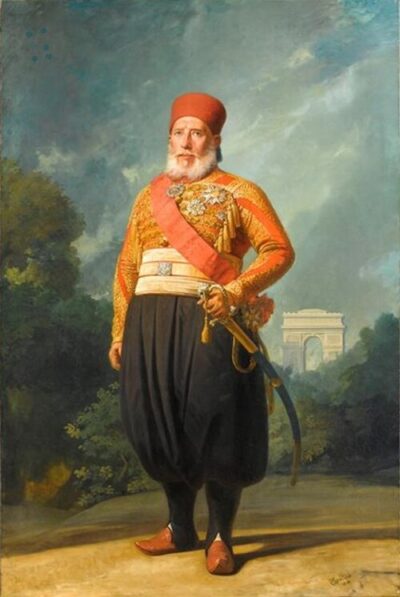
Ibrahim Pasha of Egypt
Ibrahim Pasha of Egypt was an Egyptian general and Wāli of Egypt. Born March 4, 1789, in Kavala. Died November 10, 1848, in Cairo. Positions held include regent, governor and Beylerbey of Egypt. Awards include Grand Cross of the Legion of Honour, Grand Cross of the Order of the Tower and Sword and Order of Saint Joseph.
Facts
24 facts · 2 confirmed by two sources · 3 cited · 19 from one source
Where this comes from
Papalocal keeps its own record. It started from these sources; what each one said is kept here as it was copied, so a change on their side never changes this page by itself. Tap one to read its version.
What Wikidata says · copied November 16, 2026 · revision 2557927405
- Described as
- Egyptian general and Wāli of Egypt (1789–1848)
- Other names
- Ibrahim Pasza, Ibrahim Pasha, Ibrahīm Pasha ibn Muḥammad ʿAlī
- Born
- March 4, 1789
- Died
- November 10, 1848 · 2 references
- Born in
- Kavala · 1 reference
- Died in
- Cairo
- Buried in
- Cairo
- Citizen of
- Egypt · 1 reference
- Occupation
- politician · 1 reference; military personnel · 1 reference
- Positions held
- regent; governor; Beylerbey of Egypt
- Awards
- Grand Cross of the Legion of Honour; Grand Cross of the Order of the Tower and Sword; Order of Saint Joseph
- Spouse
- Hoshiyar Qadin
- Children
- Isma'il Pasha; Ahmad Rifaat Pasha; Mustafa Fazıl Paşa
- Father
- Muhammad Ali
- Mother
- Amina Hanim
- Siblings
- Sa'id of Egypt; Tusun Pasha
- Religion
- Islam
- Military rank
- general
- Wikipedias with a page
- 47
Wikidata item Q311789 (wikidata.org/wiki/Q311789), public domain (CC0). Copied November 16, 2026.
What Wikipedia says · copied November 16, 2026 · revision 1383306312
Ibrahim Pasha (Arabic: إبراهيم باشا Ibrāhīm Bāshā; 1789 – 10 November 1848) was an Egyptian general and politician; he was the commander of both the Egyptian and Ottoman armies and the eldest son of Muhammad Ali, the Ottoman Wāli and unrecognized Khedive of Egypt and Sudan. He was the second ruler of Egypt from the Muhammad Ali dynasty and ruled from 20 July 1848 to 10 November 1848.
Ibrahim served as a general in the Egyptian army that his father established during his reign, taking his first command of Egyptian forces when he was merely a teenager. In the final year of his life, he was appointed Regent for his still-living father and became the effective ruler of Egypt and Sudan, owing to the latter's ill health. His rule also extended over the other dominions that his father had brought under Egyptian rule, namely Syria, Hejaz, Morea, Thasos, and Crete. Ibrahim pre-deceased his father, dying 10 November 1848, only four months after rising to power. He was succeeded as Regent by his nephew (son of Muhammad Ali's second oldest son), Abbas, who upon Muhammad Ali's death the following year inherited the Egyptian throne.
Ibrahim remains one of the most celebrated members of the Muhammad Ali dynasty, particularly for his impressive military victories, including several crushing defeats of the Ottoman Empire, which placed him among the most outstanding commanders in military history. Among Egyptian historians, Ibrahim, his father Muhammad Ali, and his son Isma'il the Magnificent are held in far higher esteem than other rulers from the dynasty, who were largely viewed as indolent and corrupt; this is largely the result of efforts by his grandson Fuad I of Egypt to ensure the positive portrayal of his paternal ancestors in the Royal Archives that he created, which were the primary source for Egyptian history from the 1920s until the 1970s. Today, a statue of Ibrahim occupies a prominent position in Egypt's capital, Cairo.
- Born, in its opening lines
- 1789
- Died, in its opening lines
- November 10, 1848
From the Wikipedia article “Ibrahim Pasha of Egypt” (en.wikipedia.org/wiki/Ibrahim_Pasha_of_Egypt), by its contributors, under CC BY-SA 4.0 (creativecommons.org/licenses/by-sa/4.0/). Copied November 16, 2026; not changed.
Confirmed Two sources agree. Cited One source, and it names where it got it. One source One source, without a reference of its own. Sources disagree The sources disagree. We show the best-supported value and keep theirs below.
