
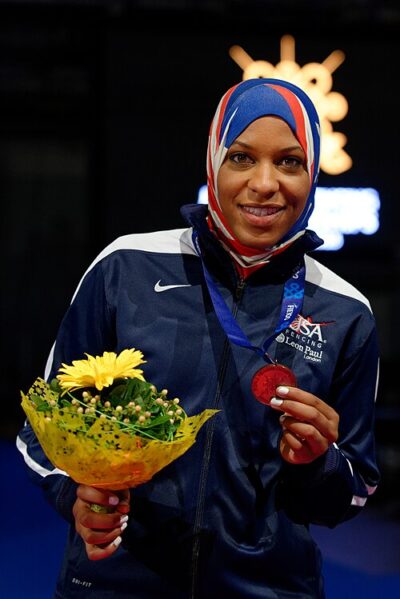
Ibtihaj Muhammad
Ibtihaj Muhammad is an American fencer. Born December 4, 1985, in Maplewood. Educated at Duke University and Columbia High School.
Facts
10 facts · 1 confirmed by two sources · 1 cited · 8 from one source
Where this comes from
Papalocal keeps its own record. It started from these sources; what each one said is kept here as it was copied, so a change on their side never changes this page by itself. Tap one to read its version.
What Wikidata says · copied November 15, 2026 · revision 2569776555
- Described as
- American fencer
- Born
- December 4, 1985
- Born in
- Maplewood
- Citizen of
- United States
- Occupation
- fencer; athlete · 1 reference
- Education
- Duke University; Columbia High School · 1 reference
- Sport
- fencing
- Religion
- Islam
- Height
- 1.70 m (5 ft 7 in)
- Wikipedias with a page
- 34
Wikidata item Q3147556 (wikidata.org/wiki/Q3147556), public domain (CC0). Copied November 15, 2026.
What Wikipedia says · copied November 15, 2026 · revision 1379608427
Ibtihaj Muhammad (born December 4, 1985) is an American sabre fencer, author, entrepreneur and Olympic medalist. At the 2016 Summer Olympics, she became the first American woman to compete in the Olympics in hijab, the first American Muslim woman to win an Olympic medal, and the first Black woman to win an Olympic medal in the sabre event, when she won bronze in the women's saber team event.
Muhammad is a five-time World medalist (2011, 2012, 2013, 2015) and at the 2014 World Fencing Championships, won gold with the United States women's sabre team.
Muhammad was named one of Time 100's Most Influential People in the World (2016), is a sports ambassador for the United States Department of State and is a New York Times Bestselling author.
- Born, in its opening lines
- December 4, 1985
From the Wikipedia article “Ibtihaj Muhammad” (en.wikipedia.org/wiki/Ibtihaj_Muhammad), by its contributors, under CC BY-SA 4.0 (creativecommons.org/licenses/by-sa/4.0/). Copied November 15, 2026; not changed.
Confirmed Two sources agree. Cited One source, and it names where it got it. One source One source, without a reference of its own. Sources disagree The sources disagree. We show the best-supported value and keep theirs below.
