
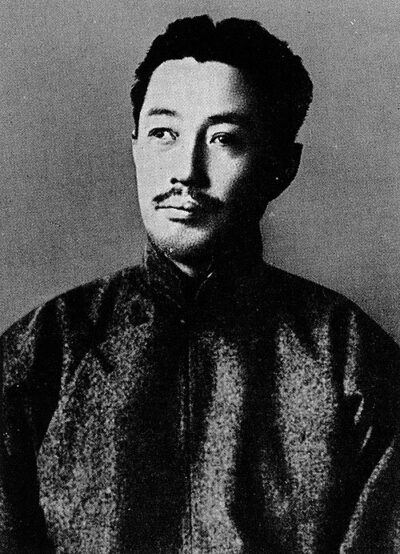
Ikki Kita
Ikki Kita was a Japanese philosopher and right-wing activist. Born April 3, 1883, in Minato. Died August 19, 1937, in Tokyo Army Prison. Known for Kokutairon and Pure Socialism and An Outline Plan for the Reorganization of Japan. Educated at Waseda University.
Facts
17 facts · 2 confirmed by two sources · 1 cited · 13 from one source · 1 where the sources disagree
What’s different
- Buried in: we show Shōkō-ji (Sources disagree). Wikidata also lists Ryūsen-ji Temple
Where this comes from
Papalocal keeps its own record. It started from these sources; what each one said is kept here as it was copied, so a change on their side never changes this page by itself. Tap one to read its version.
What Wikidata says · copied November 18, 2026 · revision 2545702460
- Described as
- Japanese philosopher and right-wing activist
- Born
- April 3, 1883
- Died
- August 19, 1937
- Born in
- Minato
- Died in
- Tokyo Army Prison
- Buried in
- Shōkō-ji; Ryūsen-ji Temple
- Cause of death
- gunshot wound
- Name at birth
- Kita · 1 reference
- Citizen of
- Empire of Japan
- Occupation
- writer; philosopher; prose writer; Esperantist · 1 reference
- Political party
- Tongmenghui
- Education
- Waseda University
- Known for
- Kokutairon and Pure Socialism; An Outline Plan for the Reorganization of Japan
- Siblings
- Kita Reikichi
- Wikipedias with a page
- 22
Wikidata item Q721416 (wikidata.org/wiki/Q721416), public domain (CC0). Copied November 18, 2026.
What Wikipedia says · copied November 18, 2026 · revision 1376652861
Kita Ikki (北 一輝, Kita Ikki; 3 April 1883 – 19 August 1937; real name: Kita Terujirō (北 輝次郎)) was a Japanese author and political philosopher who was active in early Shōwa period Japan. Drawing from an eclectic range of influences, Kita was a self-described socialist who has also been described by detractors as the "ideological father of Japanese fascism", though this has been highly contested, as his writings touched equally upon pan-Asianism, Nichiren Buddhism, fundamental human rights and egalitarianism and he was involved with Chinese revolutionary circles. While his publications were invariably censored and he ceased writing after 1923, Kita was an inspiration for elements on the far-right of Japanese politics into the 1930s, particularly his advocacy for territorial expansion and a military coup. The government saw Kita's ideas as disruptive and dangerous; in 1936 he was arrested for allegedly joining the failed coup attempt of 26 February 1936 and executed on 19 August 1937.
- Born, in its opening lines
- April 3, 1883
- Died, in its opening lines
- August 19, 1937
From the Wikipedia article “Kita Ikki” (en.wikipedia.org/wiki/Kita_Ikki), by its contributors, under CC BY-SA 4.0 (creativecommons.org/licenses/by-sa/4.0/). Copied November 18, 2026; not changed.
Confirmed Two sources agree. Cited One source, and it names where it got it. One source One source, without a reference of its own. Sources disagree The sources disagree. We show the best-supported value and keep theirs below.
