
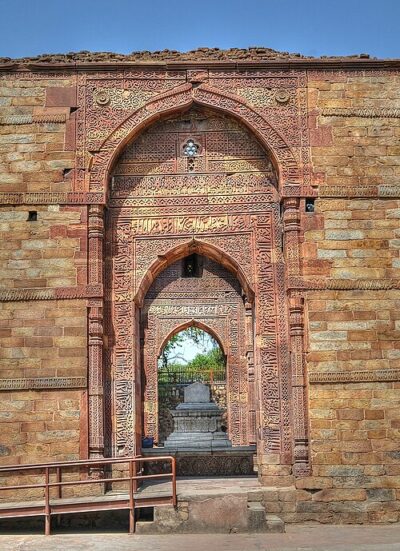
Iltutmish
Iltutmish was the 13th century ruler of the Delhi Sultinate. Born 1192. Died April 28, 1236, in Mehrauli. Positions held include Sultan of Hindustan (Sultan of Delhi) (1211–1236).
Facts
13 facts · 1 confirmed by two sources · 0 cited · 11 from one source · 1 where the sources disagree
What’s different
- Died: we show April 28, 1236 (Sources disagree). Wikipedia says April 30, 1236
Where this comes from
Papalocal keeps its own record. It started from these sources; what each one said is kept here as it was copied, so a change on their side never changes this page by itself. Tap one to read its version.
What Wikidata says · copied November 16, 2026 · revision 2553988736
- Described as
- 13th century ruler of the Delhi Sultinate
- Other names
- Shams-ud-din Iltutmish
- Born
- 1192
- Died
- April 28, 1236
- Died in
- Mehrauli
- Buried in
- Qutb complex · 1 reference
- Occupation
- politician
- Positions held
- Sultan of Hindustan (Sultan of Delhi) (1211–1236)
- Spouse
- Qutub Begum; Shah Turkan
- Children
- Nasiruddin Mahmud; Razia Sultana; Muiz ud din Bahram; Rukn ud din Firuz · 1 reference
- Religion
- Sunni Islam
- Wikipedias with a page
- 41
Wikidata item Q336312 (wikidata.org/wiki/Q336312), public domain (CC0). Copied November 16, 2026.
What Wikipedia says · copied November 16, 2026 · revision 1385113467
Shams ud-Din Iltutmish (Persian: شمس الدین اِیلتِتْمِشْ, 1192 – 30 April 1236) was the third Sultan of Delhi from 1211 to 1236. He was from the Mamluk dynasty, who ruled the former Ghurid territories in northern India. He was the first Muslim sovereign to rule from Delhi, and is thus considered the effective founder of the Delhi Sultanate.
Sold into slavery as a young boy, Iltutmish spent his early life in Bukhara and Ghazni under multiple masters. In the late 1190s, the Ghurid slave-commander Qutb ud-Din Aibak purchased him in Delhi, thus making him the slave of a slave. Iltutmish rose to prominence in Aibak's service, and was granted the important iqta' of Badaun. His military actions against the Khokhar rebels in 1205–1206 gained attention of the Ghurid ruler Muhammad of Ghor, who manumitted him even before his master Aibak was manumitted.
After Muhammad of Ghor's assassination in 1206, Aibak became a practically independent ruler of the Ghurid territories in India, with his headquarters at Lahore. After Aibak's death, Iltutmish dethroned his unpopular successor Aram Shah in 1211, and set up his capital at Delhi. He then consolidated his rule by subjugating several dissidents, and fighting against other former Ghurid slaves, such as Taj al-Din Yildiz and Nasir ad-Din Qabacha. During 1225–1227, he subjugated Aibak's former subordinates who had carved out an independent kingdom headquartered at Lakhnauti in eastern India. He also asserted his authority over Ranthambore (1226) and Mandore (1227), whose Hindu chiefs had declared independence after Aibak's death.
In the early 1220s, Iltutmish had largely stayed away from the Indus Valley region, which was embroiled in conflicts between Qabacha, the Khwarazmian dynasty, and the Mongols. In 1228, he invaded the Indus Valley region, defeated Qabacha, and annexed large parts of Punjab and Sindh to his empire. Subsequently, the Abbasid caliph al-Mustansir recognized his authority in India. Over the next few years, Iltutmish suppressed a rebellion in Bengal, captured Gwalior, raided the Paramara-controlled cities of Bhilsa and Ujjain in central India, and expelled Khwarazmian subordinates in the north-west. His officers also attacked and plundered the Chandela-controlled Kalinjar area.
Iltutmish organized the administration of the Sultanate, laying the foundation for its dominance over northern India until the Mughal invasion. He introduced the silver tanka and the copper jital – the two basic coins of the Sultanate period, with a standard weight of 175 grains. He set up the Iqtadari system: division of empire into Iqtas, which were assigned to the nobles and officers in lieu of salary. He erected many buildings, including mosques, khanqahs (monasteries), dargahs (shrines or graves of influential people) and a reservoir (hawz) for pilgrims.
- Born, in its opening lines
- 1192
- Died, in its opening lines
- April 30, 1236
From the Wikipedia article “Iltutmish” (en.wikipedia.org/wiki/Iltutmish), by its contributors, under CC BY-SA 4.0 (creativecommons.org/licenses/by-sa/4.0/). Copied November 16, 2026; not changed.
Confirmed Two sources agree. Cited One source, and it names where it got it. One source One source, without a reference of its own. Sources disagree The sources disagree. We show the best-supported value and keep theirs below.
