
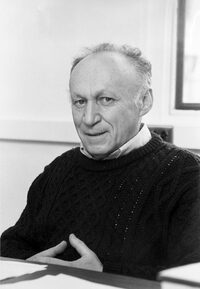
Ilya Piatetski-Shapiro
Ilya Piatetski-Shapiro was a Russian mathematician. Born March 30, 1929, in Moscow. Died February 21, 2009, in Tel Aviv. Known for Converse theorem. Educated at Moscow Pedagogical State University and MSU Faculty of Mechanics and Mathematics. Awards include Guggenheim Fellowship, Israel Prize and Wolf Prize in Mathematics.
Facts
25 facts · 2 confirmed by two sources · 10 cited · 12 from one source · 1 where the sources disagree
What’s different
- Name at birth: we show Илья́ Ио́сифович Пяте́цкий-Шапи́ро (Sources disagree). Wikidata also lists איליה פיאטצקי-שפירו
Where this comes from
Papalocal keeps its own record. It started from these sources; what each one said is kept here as it was copied, so a change on their side never changes this page by itself. Tap one to read its version.
What Wikidata says · copied November 18, 2026 · revision 2567253451
- Described as
- Russian mathematician (1929–2009)
- Other names
- Ilya Iosifovich Pyatetsky-Shapiro
- Born
- March 30, 1929 · 2 references
- Died
- February 21, 2009 · 3 references
- Born in
- Moscow
- Died in
- Tel Aviv
- Buried in
- Kiryat Shaul Cemetery
- Name at birth
- Илья́ Ио́сифович Пяте́цкий-Шапи́ро · 1 reference; איליה פיאטצקי-שפירו · 1 reference
- Citizen of
- Israel; Soviet Union; Russia
- Occupation
- mathematician · 1 reference
- Worked for
- Yale University (1977–1999) · 1 reference; Keldysh Institute of Applied Mathematics (1958–1974) · 1 reference; Tel Aviv University (1977–1999) · 1 reference; Lomonosov Moscow State University (1965–1968) · 1 reference
- Education
- Moscow Pedagogical State University (1951–1954) · 1 reference; MSU Faculty of Mechanics and Mathematics (–1951) · 1 reference
- Member of
- Israel Academy of Sciences and Humanities
- Known for
- Converse theorem
- Awards
- Guggenheim Fellowship (1992) · 1 reference; Israel Prize (1981) · 1 reference; Wolf Prize in Mathematics (1990) · 1 reference
- Field
- number theory; algebraic geometry; representation theory; mathematics
- Wikipedias with a page
- 23
Wikidata item Q718045 (wikidata.org/wiki/Q718045), public domain (CC0). Copied November 18, 2026.
What Wikipedia says · copied November 18, 2026 · revision 1372012929
Ilya Piatetski-Shapiro (Hebrew: איליה פיאטצקי-שפירו; Russian: Илья Иосифович Пятецкий-Шапиро, romanized: Ilya Iosifovich Pyatetsky-Shapiro; 30 March 1929 – 21 February 2009) was a Soviet-Israeli mathematician. During a career that spanned 60 years he made major contributions to applied science as well as pure mathematics. In his last forty years, his research focused on pure mathematics; in particular, analytic number theory, group representations and algebraic geometry. His main contribution and impact was in the area of automorphic forms and L-functions.
For the last 30 years of his life he suffered from Parkinson's disease. With the help of his wife Edith, he was able to continue to work and do mathematics at the highest level, even when he was barely able to walk and speak.
- Born, in its opening lines
- March 30, 1929
- Died, in its opening lines
- February 21, 2009
From the Wikipedia article “Ilya Piatetski-Shapiro” (en.wikipedia.org/wiki/Ilya_Piatetski-Shapiro), by its contributors, under CC BY-SA 4.0 (creativecommons.org/licenses/by-sa/4.0/). Copied November 18, 2026; not changed.
Confirmed Two sources agree. Cited One source, and it names where it got it. One source One source, without a reference of its own. Sources disagree The sources disagree. We show the best-supported value and keep theirs below.
