
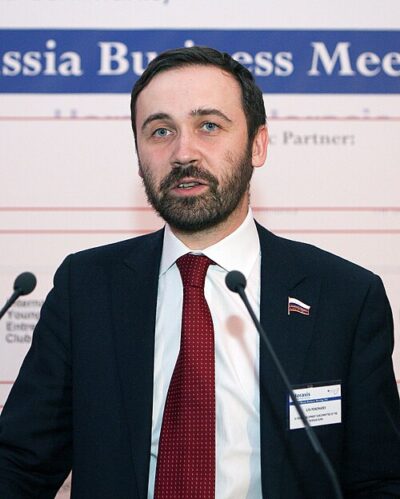
Ilya Ponomarev
Ilya Ponomarev is a Russian-Ukrainian politician and entrepreneur. Born August 6, 1975, in Moscow. Positions held include member of the State Duma (2007–2016). Educated at Russian State Social University.
Facts
19 facts · 1 confirmed by two sources · 1 cited · 17 from one source
Where this comes from
Papalocal keeps its own record. It started from these sources; what each one said is kept here as it was copied, so a change on their side never changes this page by itself. Tap one to read its version.
What Wikidata says · copied November 17, 2026 · revision 2563068236
- Described as
- Russian-Ukrainian politician and entrepreneur
- Other names
- Ilya Vladimirovich Ponomarev, Ilya Ponomaryov
- Born
- August 6, 1975
- Born in
- Moscow
- Citizen of
- Russia (1991–2019); Soviet Union (1975–1991); Ukraine (2019–) · 1 reference
- Occupation
- politician; entrepreneur
- Positions held
- member of the State Duma (2007–2016)
- Political party
- Communist Party of the Russian Federation (2002–2007); Left Front; A Just Russia (2007–2013); Green Alliance–The People's Party (2014–)
- Education
- Russian State Social University (–2011)
- Member of
- 6th State Duma of the Russian Federation; 5th State Duma of the Russian Federation
- Father
- Vladimir Ponomaryov · 1 reference
- Mother
- Larisa Ponomaryova · 1 reference
- Lived in
- Kyiv
- Website
- http://ilya-ponomarev.livejournal.com
- Wikipedias with a page
- 27
Wikidata item Q4371978 (wikidata.org/wiki/Q4371978), public domain (CC0). Copied November 17, 2026.
What Wikipedia says · copied November 17, 2026 · revision 1382406788
Ilya Vladimirovich Ponomarev (born 6 August 1975) is a Russian-born Ukrainian politician.
A member of the Russian State Duma from 2007 to 2016, he notably chose not to vote in favour of the Russian gay propaganda law (he abstained) and to vote against Russia's annexation of Crimea in March 2014. In 2015, while in the United States, Ponomarev was formally charged in Russia with embezzlement, which he called politically motivated. In 2016, he was impeached for not performing his duties, and he went into exile in Ukraine, where he obtained Ukrainian citizenship in 2019.
Following the start of the Russian invasion of Ukraine in 2022, Ponomarev stated that he had joined Ukraine's Territorial Defense Forces, and he denounced the invasion. Ponomarev also endorsed acts of sabotage and arson in Russia, and launched a Russian-language opposition television channel called February Morning (Russian: Утро Февраля, romanized: Utro Fevralya). Following the killing of Darya Dugina, Ponomarev has claimed to have been in contact with a hitherto-unknown group called the National Republican Army which he said claimed responsibility for the killing. He claims not to be a member but a supporter who is trusted to receive press releases. Ponomarev's claims have been treated by observers with scepticism.
Ponomarev is the author of the book, Does Putin Have to Die?: The Story of How Russia Becomes a Democracy after Losing to Ukraine, released 4 October 2022 by Skyhorse Publishing.
- Born, in its opening lines
- August 6, 1975
From the Wikipedia article “Ilya Ponomarev” (en.wikipedia.org/wiki/Ilya_Ponomarev), by its contributors, under CC BY-SA 4.0 (creativecommons.org/licenses/by-sa/4.0/). Copied November 17, 2026; not changed.
Confirmed Two sources agree. Cited One source, and it names where it got it. One source One source, without a reference of its own. Sources disagree The sources disagree. We show the best-supported value and keep theirs below.
