
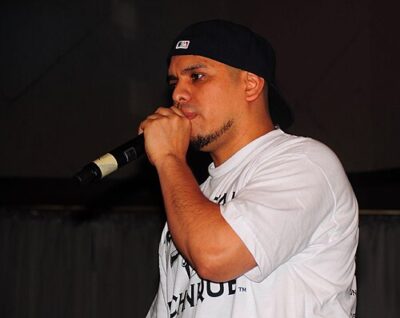
Immortal Technique
Immortal Technique is an American rapper. Born February 19, 1978, in Lima. Educated at Pennsylvania State University and Baruch College.
Facts
16 facts · 1 confirmed by two sources · 0 cited · 15 from one source
Where this comes from
Papalocal keeps its own record. It started from these sources; what each one said is kept here as it was copied, so a change on their side never changes this page by itself. Tap one to read its version.
What Wikidata says · copied November 15, 2026 · revision 2563867441
- Described as
- American rapper
- Other names
- Felipe Andres Coronel, Felipe Coronel
- Born
- February 19, 1978
- Born in
- Lima
- Citizen of
- United States; Peru
- Occupation
- rapper; activist
- Education
- Pennsylvania State University; Baruch College; Hunter College High School · 1 reference
- Genre
- hip-hop; East Coast hip-hop; underground hip-hop; political hip-hop; hardcore hip-hop
- Instrument
- voice
- Website
- http://www.viperrecords.com
- Wikipedias with a page
- 28
Wikidata item Q347368 (wikidata.org/wiki/Q347368), public domain (CC0). Copied November 15, 2026.
What Wikipedia says · copied November 15, 2026 · revision 1381492127
Felipe Andres Coronel (born February 19, 1978), better known by his stage name Immortal Technique, is an American rapper, songwriter, and activist of Afro-Peruvian descent. His lyrics largely feature commentary on issues such as politics, religion, institutional racism, socioeconomics and government conspiracies.
Immortal Technique seeks to retain control over his production, and has stated in his music that record companies profit the most from music over the artists themselves. He claimed in 2009 to have sold close to a combined total of 200,000 copies of his first three official releases.
- Born, in its opening lines
- February 19, 1978
From the Wikipedia article “Immortal Technique” (en.wikipedia.org/wiki/Immortal_Technique), by its contributors, under CC BY-SA 4.0 (creativecommons.org/licenses/by-sa/4.0/). Copied November 15, 2026; not changed.
Confirmed Two sources agree. Cited One source, and it names where it got it. One source One source, without a reference of its own. Sources disagree The sources disagree. We show the best-supported value and keep theirs below.
