
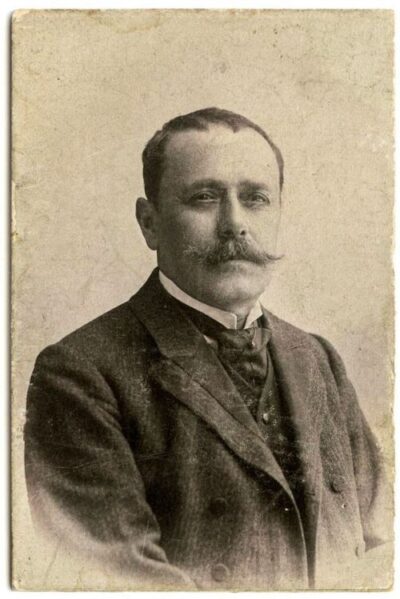
Ion Luca Caragiale
Ion Luca Caragiale was a Romanian playwright, writer and poet. Born February 13, 1852, in I.L. Caragiale. Died June 9, 1912, in Berlin. Awards include Order of the Star of Romania.
Facts
28 facts · 2 confirmed by two sources · 11 cited · 15 from one source
Where this comes from
Papalocal keeps its own record. It started from these sources; what each one said is kept here as it was copied, so a change on their side never changes this page by itself. Tap one to read its version.
What Wikidata says · copied November 16, 2026 · revision 2565538639
- Described as
- Romanian playwright, writer and poet (1852-1912)
- Other names
- Caragiale, Luca Ion Palicar Caragiale
- Born
- February 13, 1852
- Died
- June 9, 1912 · 4 references
- Born in
- I.L. Caragiale
- Died in
- Berlin · 1 reference
- Buried in
- Bellu Cemetery
- Citizen of
- Principality of Wallachia; United Principalities of Moldavia and Wallachia; Kingdom of Romania
- Occupation
- linguist; poet · 1 reference; writer · 3 references; journalist · 1 reference; playwright · 2 references; children's writer; translator; short story writer
- Political party
- Conservative-Democratic Party
- Member of
- Romanian Academy
- Genre
- drama fiction
- Awards
- Order of the Star of Romania
- Field
- literature · 1 reference; drama · 1 reference; poetry · 1 reference; translation · 1 reference; journalism · 1 reference
- Spouse
- Alexandrina Burelly (1889–)
- Children
- Luca Caragiale; Mateiu Caragiale · 1 reference
- Wikipedias with a page
- 47
Wikidata item Q315132 (wikidata.org/wiki/Q315132), public domain (CC0). Copied November 16, 2026.
What Wikipedia says · copied November 16, 2026 · revision 1378406284
Ion Luca Caragiale (Romanian pronunciation: [iˈon ˈluka karaˈdʒjale]; 13 February [O.S. 1 February] 1852 – 9 June 1912), commonly referred to as I. L. Caragiale, was a Romanian playwright, short story writer, poet, theater manager, political commentator and journalist. Leaving behind an important cultural legacy, he is considered one of the greatest playwrights in Romanian language and literature, as well as one of its most important writers and a leading representative of local humour. Alongside Mihai Eminescu, Ioan Slavici and Ion Creangă, he is seen as one of the main representatives of Junimea, an influential literary society with which he nonetheless parted during the second half of his life. His work, spanning four decades, covers the ground between Neoclassicism, Realism, and Naturalism, building on an original synthesis of foreign and local influences.
Although few in number, Caragiale's plays constitute the most accomplished expression of Romanian theatre, as well as being important venues for criticism of late-19th-century Romanian society. They include the comedies O noapte furtunoasă, Conu Leonida față cu reacțiunea, O scrisoare pierdută, and the tragedy Năpasta. In addition to these, Caragiale authored a large number of essays, articles, short stories, novellas and sketch stories, as well as occasional works of poetry and autobiographical texts such as Din carnetul unui vechi sufleur. In many cases, his creations were first published in one of several magazines he edited — Claponul, Vatra, and Epoca. In some of his later fiction writings, including La hanul lui Mânjoală, Kir Ianulea, Abu-Hasan, Pastramă trufanda and Calul dracului, Caragiale adopted the fantasy genre or turned to historical fiction.
Ion Luca Caragiale was interested in the politics of the Romanian Kingdom, and oscillated between the liberal current and conservatism. Most of his satirical works target the liberal republicans and the National Liberals, evidencing both his respect for their rivals at Junimea and his connections with the literary critic Titu Maiorescu. He came to clash with National Liberal leaders such as Dimitrie Sturdza and Bogdan Petriceicu Hasdeu, and was a lifelong adversary of the Symbolist poet Alexandru Macedonski. As a result of these conflicts, the most influential of Caragiale's critics barred his access to the cultural establishment for several decades. During the 1890s, Caragiale rallied with the radical movement of George Panu, before associating with the Conservative Party. After having decided to settle in Berlin, he came to voice strong criticism for Romanian politicians of all colours in the wake of the 1907 Romanian Peasants' Revolt, and ultimately joined the Conservative-Democratic Party of Tache Ionescu.
He was both a friend and rival to writers such as Mihai Eminescu, Titu Maiorescu, and Barbu Ștefănescu Delavrancea, while maintaining contacts with, among others, the Junimist essayist Iacob Negruzzi, the socialist philosopher Constantin Dobrogeanu-Gherea, the literary critic Paul Zarifopol, the poets George Coșbuc and Mite Kremnitz, the psychologist Constantin Rădulescu-Motru, and the Transylvanian poet and activist Octavian Goga. Ion Luca was the nephew of Costache and Iorgu Caragiale, who were major figures of the 19th century Romanian theatre. His sons Mateiu and Luca were both modernist writers.
- Born, in its opening lines
- February 13, 1852
- Died, in its opening lines
- June 9, 1912
From the Wikipedia article “Ion Luca Caragiale” (en.wikipedia.org/wiki/Ion_Luca_Caragiale), by its contributors, under CC BY-SA 4.0 (creativecommons.org/licenses/by-sa/4.0/). Copied November 16, 2026; not changed.
Confirmed Two sources agree. Cited One source, and it names where it got it. One source One source, without a reference of its own. Sources disagree The sources disagree. We show the best-supported value and keep theirs below.
