
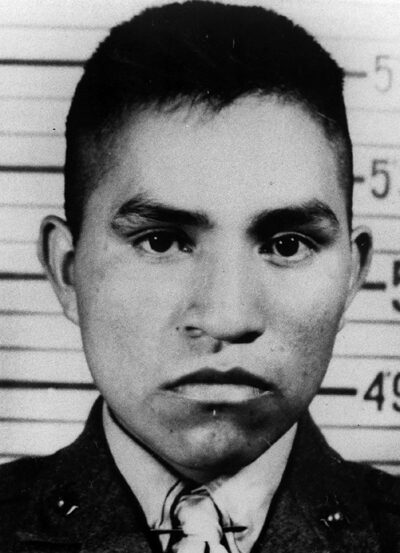
Ira Hayes
Ira Hayes was a Native American United States Marine. Born January 12, 1923, in Sacaton. Died January 24, 1955, in Bapchule. Awards include World War II Victory Medal.
Facts
11 facts · 2 confirmed by two sources · 0 cited · 9 from one source
Where this comes from
Papalocal keeps its own record. It started from these sources; what each one said is kept here as it was copied, so a change on their side never changes this page by itself. Tap one to read its version.
What Wikidata says · copied November 18, 2026 · revision 2539248390
- Described as
- Native American United States Marine (1923-1955)
- Other names
- Ira Hamilton Hayes
- Born
- January 12, 1923 · 2 references
- Died
- January 24, 1955 · 2 references
- Born in
- Sacaton
- Died in
- Bapchule
- Buried in
- Arlington National Cemetery
- Citizen of
- United States
- Occupation
- paratrooper
- Sport
- skydiving
- Awards
- World War II Victory Medal
- Military branch
- United States Marine Corps
- Military rank
- Corporal
- Wikipedias with a page
- 17
Wikidata item Q640630 (wikidata.org/wiki/Q640630), public domain (CC0). Copied November 18, 2026.
What Wikipedia says · copied November 18, 2026 · revision 1386040417
Ira Hamilton Hayes (January 12, 1923 – January 24, 1955) was a United States Marine during World War II. Hayes was an enrolled member of the Gila River Indian Community, located in Pinal and Maricopa counties in Arizona. He enlisted in the United States Marine Corps Reserve on August 26, 1942, and, after recruit training, volunteered to become a Paramarine. He fought in the Bougainville and Iwo Jima campaigns in the Pacific War.
Hayes was one of the six men who appeared in the iconic photograph Raising the Flag on Iwo Jima by photographer Joe Rosenthal. The first flag raised over Mount Suribachi on February 23, 1945 at the south end of Iwo Jima, was deemed too small and was replaced the same day by a larger flag. A photo of the second flag-raising, which included Hayes in it, became famous and was widely reproduced. After the battle, Hayes and two other men were identified as surviving second flag-raisers and were reassigned to help raise funds for the Seventh War Loan drive. In 1946, after his service in the Marine Corps, he was instrumental in revealing the correct identity of one of the Marines in the photograph.
After the war, Hayes suffered from post-traumatic stress disorder and descended into alcoholism. On November 10, 1954, he attended the dedication of the Marine Corps War Memorial in Arlington County, Virginia, which was modeled after the photograph of Hayes and five other Marines raising the second flag on Iwo Jima. After a night of heavy drinking on January 23–24, 1955, he died of exposure due to the cold and alcohol poisoning. He was buried with full military honors at Arlington National Cemetery on February 2, 1955.
Hayes was commemorated in art and film, before and after his death. In 1949, he portrayed himself raising the flag in the movie Sands of Iwo Jima, starring John Wayne. He was the subject of an article by journalist William Bradford Huie, which was adapted for the feature film The Outsider (1961), starring Tony Curtis as Hayes. The movie inspired songwriter Peter La Farge to write "The Ballad of Ira Hayes", which became popular nationwide in 1964 after being recorded by Johnny Cash. In 2006, Hayes was portrayed by Adam Beach in the World War II movie Flags of Our Fathers, directed by Clint Eastwood.
- Born, in its opening lines
- January 12, 1923
- Died, in its opening lines
- January 24, 1955
From the Wikipedia article “Ira Hayes” (en.wikipedia.org/wiki/Ira_Hayes), by its contributors, under CC BY-SA 4.0 (creativecommons.org/licenses/by-sa/4.0/). Copied November 18, 2026; not changed.
Confirmed Two sources agree. Cited One source, and it names where it got it. One source One source, without a reference of its own. Sources disagree The sources disagree. We show the best-supported value and keep theirs below.
