
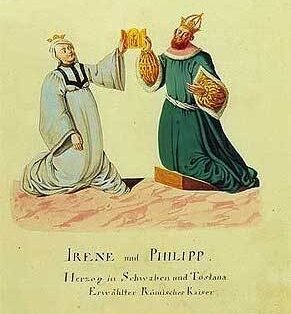
Irene Angelina was a Byzantine queen. Born 1181, in Constantinople. Died August 27, 1208, in Hohenstaufen Castle.
Facts
18 facts · 2 confirmed by two sources · 7 cited · 9 from one source
What’s different
- Born: we show 1181 (Confirmed). Wikidata also lists 1180
Where this comes from
Papalocal keeps its own record. It started from these sources; what each one said is kept here as it was copied, so a change on their side never changes this page by itself. Tap one to read its version.
What Wikidata says · copied November 16, 2026 · revision 2569015055
- Described as
- Byzantine queen (1180-1208)
- Other names
- Irene Angelo Doukas
- Born
- 1181; 1180 · 1 reference
- Died
- August 27, 1208
- Born in
- Constantinople
- Died in
- Hohenstaufen Castle
- Buried in
- Kloster Lorch
- Cause of death
- puerperal disorders
- Citizen of
- Byzantine Empire
- Occupation
- queen regnant
- Spouse
- Philip of Swabia (1197–) · 2 references; Roger III of Sicily (1192–) · 1 reference
- Children
- Beatrice of Swabia · 1 reference; Kunigunde of Hohenstaufen · 1 reference; Elisabeth of Swabia · 1 reference; Marie of Hohenstaufen · 1 reference
- Father
- Isaac II Angelos · 1 reference
- Mother
- Irene Palaiologos · 1 reference
- Siblings
- Alexios IV Angelos; John Angelus of Syrmia
- Wikipedias with a page
- 30
Wikidata item Q119431 (wikidata.org/wiki/Q119431), public domain (CC0). Copied November 16, 2026.
What Wikipedia says · copied November 16, 2026 · revision 1383216206
Irene Angelina (Greek: Εἰρήνη Ἀγγελίνα; c. 1181 – 27 August 1208) was a Byzantine princess and member of the Angelos dynasty and by her two marriages Queen of Sicily in 1193 and Queen of Germany from 1198 to 1208.
- Born, in its opening lines
- c. 1181
- Died, in its opening lines
- August 27, 1208
From the Wikipedia article “Irene Angelina” (en.wikipedia.org/wiki/Irene_Angelina), by its contributors, under CC BY-SA 4.0 (creativecommons.org/licenses/by-sa/4.0/). Copied November 16, 2026; not changed.
Confirmed Two sources agree. Cited One source, and it names where it got it. One source One source, without a reference of its own. Sources disagree The sources disagree. We show the best-supported value and keep theirs below.
