
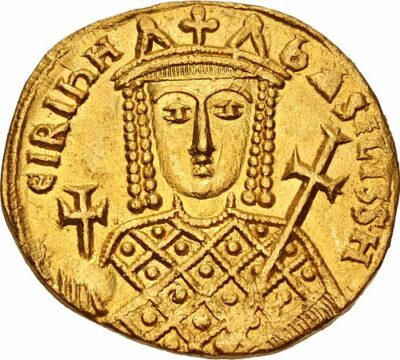
Irene of Athens
Irene of Athens was an empress of Byzantine Empire. Born 752, in Athens. Died August 9, 803, in Lesbos. Positions held include Byzantine emperor (797–802), regent (780–797) and empress consort (775–780).
Facts
12 facts · 0 confirmed by two sources · 3 cited · 9 from one source
Where this comes from
Papalocal keeps its own record. It started from these sources; what each one said is kept here as it was copied, so a change on their side never changes this page by itself. Tap one to read its version.
What Wikidata says · copied November 16, 2026 · revision 2566810692
- Described as
- empress of Byzantine Empire (752-803)
- Other names
- Eirene, Sarantapechaina, Eirene Sarantapechaina, Irene Sarantapechaina, Irene of Bulgaria, Sarantapḗchaina, Sarantapechaena, Irene
- Born
- 752 · 5 references
- Died
- August 9, 803 · 2 references
- Born in
- Athens · 1 reference
- Died in
- Lesbos · 1 reference
- Buried in
- Church of the Holy Apostles
- Citizen of
- Byzantine Empire
- Occupation
- politician
- Positions held
- Byzantine emperor (797–802); regent (780–797); empress consort (775–780)
- Spouse
- Leo IV the Khazar (768–) · 2 references
- Children
- Konstantinos VI
- Wikipedias with a page
- 66
Wikidata item Q206737 (wikidata.org/wiki/Q206737), public domain (CC0). Copied November 16, 2026.
What Wikipedia says · copied November 16, 2026 · revision 1377050191
Irene of Athens (Greek: Εἰρήνη, Eirḗnē; 750/756 – 9 August 803), surname Sarantapechaena (Greek: Σαρανταπήχαινα, Sarantapḗchaina), was Byzantine empress consort to Emperor Leo IV from 775 to 780, regent during the childhood of their son Constantine VI from 780 until 790, co-ruler from 792 until 797, and finally empress regnant and sole ruler of the Byzantine Empire from 797 to 802. A member of the politically prominent Sarantapechos family, she was selected as Leo IV's bride for unknown reasons in 768. Even though her husband was an iconoclast, she harbored iconophile sympathies. During her regency, in 787, she called the Second Council of Nicaea which condemned iconoclasm as heretical and brought an end to the first iconoclast period (730–787). Irene's concluding five years of sole rule were unprecedented in Roman and Byzantine history. Her public figure in this period was polarizing, due to the setbacks faced by the Empire and her iconophilic stances, often attributed to her gender and the influence of her retinue.
After the death of her husband, Irene secured the throne for her family, setting herself in charge. During her regency with Constantine VI, she became very influential in government policies, largely overshadowing her son. As Constantine VI reached maturity, he began to move out from under the influence of his mother. In the early 790s, several revolts attempted to proclaim him as sole ruler. One of these revolts succeeded, but in 792 Irene was re-established in all imperial powers as "co-emperor" with Constantine VI. In 797, Irene organized a conspiracy in which her supporters gouged out her son's eyes. Constantine was imprisoned and probably died shortly afterwards. With him out of the way, Irene proclaimed herself sole ruler. Pope Leo III—already seeking to break links with the Byzantine East—used Irene's alleged unprecedented status as a female ruler of the Roman Empire to proclaim Charlemagne as Emperor of the Romans on Christmas Day of 800 under the pretext that a woman could not hold the position solely and thus the Roman throne was actually vacant. A revolt in 802 overthrew Irene and exiled her to the island of Lesbos, supplanting her on the throne with Nikephoros I. Irene died in exile less than a year later.
From the Wikipedia article “Irene of Athens” (en.wikipedia.org/wiki/Irene_of_Athens), by its contributors, under CC BY-SA 4.0 (creativecommons.org/licenses/by-sa/4.0/). Copied November 16, 2026; not changed.
Confirmed Two sources agree. Cited One source, and it names where it got it. One source One source, without a reference of its own. Sources disagree The sources disagree. We show the best-supported value and keep theirs below.
