
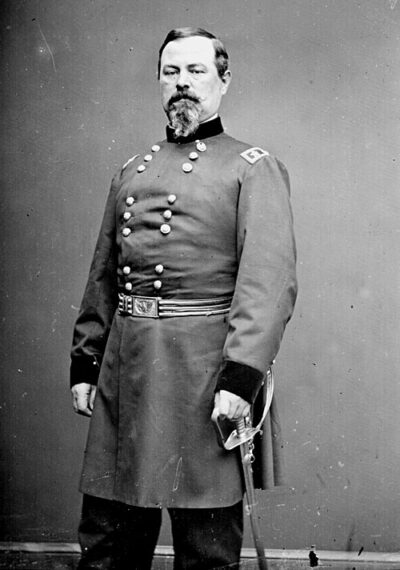
Irvin McDowell
Irvin McDowell was an American general. Born October 15, 1818, in Columbus. Died May 4, 1885, in San Francisco. Educated at United States Military Academy.
Facts
12 facts · 2 confirmed by two sources · 3 cited · 7 from one source
Where this comes from
Papalocal keeps its own record. It started from these sources; what each one said is kept here as it was copied, so a change on their side never changes this page by itself. Tap one to read its version.
What Wikidata says · copied November 15, 2026 · revision 2567096421
- Described as
- American general (1818–1885)
- Born
- October 15, 1818 · 2 references
- Died
- May 4, 1885 · 2 references
- Born in
- Columbus · 1 reference
- Died in
- San Francisco · 1 reference
- Buried in
- San Francisco National Cemetery
- Citizen of
- United States
- Occupation
- military officer; major general · 1 reference
- Education
- United States Military Academy (–1838)
- Military branch
- Union Army; United States Army
- Military rank
- major general
- Wikipedias with a page
- 26
Wikidata item Q707558 (wikidata.org/wiki/Q707558), public domain (CC0). Copied November 15, 2026.
What Wikipedia says · copied November 15, 2026 · revision 1380947074
Irvin McDowell (October 15, 1818 – May 4, 1885) was an American army officer. He is best known for his defeat in the First Battle of Bull Run, the first large-scale battle of the American Civil War. In 1862, he was given command of the I Corps of the Army of the Potomac. He fought unsuccessfully against Thomas "Stonewall" Jackson's troops during the Valley Campaign of 1862 and was blamed for contributing to the defeat of United States troops at the Second Battle of Bull Run in August.
- Born, in its opening lines
- October 15, 1818
- Died, in its opening lines
- May 4, 1885
From the Wikipedia article “Irvin McDowell” (en.wikipedia.org/wiki/Irvin_McDowell), by its contributors, under CC BY-SA 4.0 (creativecommons.org/licenses/by-sa/4.0/). Copied November 15, 2026; not changed.
Confirmed Two sources agree. Cited One source, and it names where it got it. One source One source, without a reference of its own. Sources disagree The sources disagree. We show the best-supported value and keep theirs below.
