
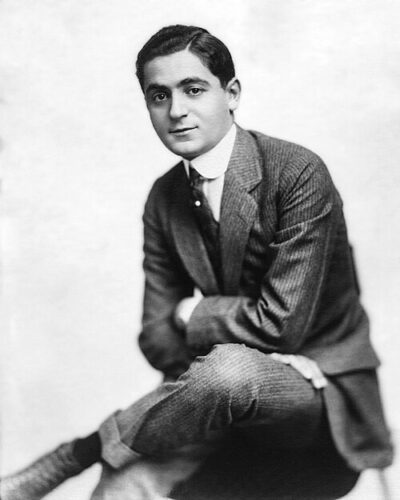
Irving Berlin
Irving Berlin was an American composer and lyricist. Born May 11, 1888, in Talachyn. Died September 22, 1989, in New York City. Known for White Christmas, Remember and Blue Skies. Awards include Presidential Medal of Freedom, Grammy Lifetime Achievement Award and Congressional Gold Medal.
Facts
43 facts · 2 confirmed by two sources · 14 cited · 26 from one source · 1 where the sources disagree
What’s different
- Born in: we show Talachyn (Sources disagree). Wikidata also lists Tyumen
Where this comes from
Papalocal keeps its own record. It started from these sources; what each one said is kept here as it was copied, so a change on their side never changes this page by itself. Tap one to read its version.
What Wikidata says · copied November 13, 2026 · revision 2568865875
- Described as
- American composer and lyricist (1888–1989)
- Other names
- I. Berlin, Israel Baline, Israel Balin, Israel Isidore Baline, Израиль Моисеевич Бейлин
- Born
- May 11, 1888 · 15 references
- Died
- September 22, 1989 · 14 references
- Born in
- Talachyn · 1 reference; Tyumen · 1 reference
- Died in
- New York City · 2 references
- Buried in
- Woodlawn Cemetery · 1 reference
- Cause of death
- myocardial infarction
- Name at birth
- Израиль Моисеевич Бейлин · 1 reference
- Citizen of
- United States (1918–) · 1 reference; Russian Empire · 1 reference
- Occupation
- composer · 3 references; pianist; songwriter; screenwriter; film score composer; lyricist; musical theatre composer · 1 reference; film screenwriter · 1 reference
- Worked for
- Ted Snyder Company (1909–1918)
- Member of
- American Society of Composers, Authors and Publishers (1914–); SACEM (1920–) · 1 reference
- Genre
- vaudeville; musical play · 1 reference
- Instrument
- piano
- Record label
- Columbia Records
- Known for
- White Christmas; Remember; Blue Skies; Always; Alexander's Ragtime Band · 1 reference
- Awards
- Presidential Medal of Freedom (1977) · 1 reference; Grammy Lifetime Achievement Award (1968) · 1 reference; Congressional Gold Medal; Medal of Liberty · 1 reference; Academy Award for Best Original Song (1943) · 1 reference; star on Hollywood Walk of Fame · 1 reference; Tony Award for Best Original Score (1951) · 1 reference
- Spouse
- Dorothy Goetz (1912); Ellin Berlin
- Children
- Mary Ellin Barrett
- Father
- Moses Beilin · 1 reference
- Mother
- Lena Jarchin · 1 reference
- Military branch
- United States Army
- Lived in
- New York City (1947–1989)
- Wikipedias with a page
- 73
Wikidata item Q128746 (wikidata.org/wiki/Q128746), public domain (CC0). Copied November 13, 2026.
What Wikipedia says · copied November 13, 2026 · revision 1384355608
Irving Berlin (born Israel Isidore Beilin; May 11, 1888 – September 22, 1989) was a Russian-born American songwriter and composer. His music forms a large part of the Great American Songbook. Berlin received numerous honors including an Academy Award, a Grammy Award, and a Tony Award. He also received the Presidential Medal of Freedom from President Gerald R. Ford in 1977. The broadcast journalist Walter Cronkite stated he "helped write the story of this country, capturing the best of who we are and the dreams that shape our lives".
Born in Russia, Berlin arrived in the United States at the age of five. His family left Russia to escape pogroms against the Jewish village of Tolochin. He published his first song, "Marie from Sunny Italy", in 1907, receiving 33 cents for the publishing rights, and became known as the composer of numerous international hits, starting with 1911's "Alexander's Ragtime Band". He also was an owner of the Music Box Theatre on Broadway. For much of his career, Berlin could not read sheet music, and was such a limited piano player that he could only play in the key of F-sharp; he used his custom piano equipped with a transposing lever when he needed to play in keys other than F-sharp. He was known for writing music and lyrics in the American vernacular: uncomplicated, simple and direct, with his stated aim being to "reach the heart of the average American", whom he saw as the "real soul of the country".
He wrote hundreds of songs, many becoming major hits, which made him famous before he turned thirty. During his 60-year career he wrote an estimated 1,500 songs, including the scores for 20 original Broadway shows and 15 original Hollywood films, with his songs nominated eight times for Academy Awards. Many songs became popular themes and anthems, including "God Bless America", "Alexander's Ragtime Band", "Blue Skies", "Easter Parade", "Puttin' on the Ritz", "Cheek to Cheek", "White Christmas", "Happy Holiday", "Anything You Can Do (I Can Do Better)", and "There's No Business Like Show Business".
His Broadway musical This Is the Army (1942) was adapted into the 1943 film of the same name.
Berlin's songs have reached the top of the US charts 25 times and have been extensively re-recorded by numerous singers. Berlin died in 1989 at the age of 101. Composer Douglas Moore sets Berlin apart from all other contemporary songwriters, and includes him instead with Stephen Foster, Walt Whitman, and Carl Sandburg, as a "great American minstrel"—someone who has "caught and immortalized in his songs what we say, what we think about, and what we believe." Composer George Gershwin called him "the greatest songwriter that has ever lived", and composer Jerome Kern concluded that "Irving Berlin has no place in American music—he is American music."
- Born, in its opening lines
- May 11, 1888
- Died, in its opening lines
- September 22, 1989
From the Wikipedia article “Irving Berlin” (en.wikipedia.org/wiki/Irving_Berlin), by its contributors, under CC BY-SA 4.0 (creativecommons.org/licenses/by-sa/4.0/). Copied November 13, 2026; not changed.
Confirmed Two sources agree. Cited One source, and it names where it got it. One source One source, without a reference of its own. Sources disagree The sources disagree. We show the best-supported value and keep theirs below.
