
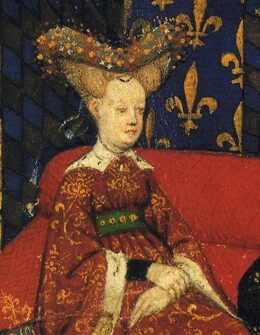
Isabeau of Bavaria
Isabeau of Bavaria was a Queen Consort of France. Born 1370, in Munich. Died September 24, 1435, in Paris. Positions held include regent.
Facts
25 facts · 2 confirmed by two sources · 11 cited · 12 from one source
Where this comes from
Papalocal keeps its own record. It started from these sources; what each one said is kept here as it was copied, so a change on their side never changes this page by itself. Tap one to read its version.
What Wikidata says · copied November 16, 2026 · revision 2569840158
- Described as
- Queen Consort of France
- Other names
- Isabella of Bavaria
- Born
- 1370
- Died
- September 24, 1435 · 1 reference
- Born in
- Munich · 1 reference
- Died in
- Paris · 1 reference
- Buried in
- Basilica of Saint-Denis
- Citizen of
- France
- Occupation
- regent
- Positions held
- regent
- Spouse
- Charles VI of France (1385–1422) · 4 references
- Children
- Isabella of Valois · 1 reference; Joan of France, Duchess of Brittany; Marie, Prioress of Poissy; Michelle of Valois · 1 reference; Louis, Dauphin of France, Duke of Guyenne; John, Dauphin of France, Duke of Touraine · 1 reference; Catherine of Valois · 1 reference; Charles VII of France · 1 reference; Charles, Dauphin of France · 1 reference; Philippe de Valois · 2 references; Charles de France
- Father
- Stephen III, Duke of Bavaria · 1 reference
- Mother
- Taddea Visconti
- Siblings
- Johann von Moosburg; Louis VII, Duke of Bavaria · 1 reference
- Religion
- Catholicism
- Wikipedias with a page
- 48
Wikidata item Q154064 (wikidata.org/wiki/Q154064), public domain (CC0). Copied November 16, 2026.
What Wikipedia says · copied November 16, 2026 · revision 1382592052
Isabeau of Bavaria (or Isabelle; also Elisabeth of Bavaria-Ingolstadt; c. 1370 – 24 September 1435) was Queen of France as the wife of King Charles VI from 1385 to 1422. She was born into the House of Wittelsbach as the only daughter of Duke Stephen III of Bavaria-Ingolstadt and Taddea Visconti of Milan. At age 15 or 16, Isabeau was sent to France to marry the young Charles VI; the couple wed three days after their first meeting. Isabeau was honored in 1389 with a lavish coronation ceremony and entry into Paris.
In 1392, Charles suffered the first attack of what was to become a lifelong and progressive mental illness, resulting in periodic withdrawal from government. The episodes occurred with increasing frequency, leaving a court both divided by political factions and steeped in social extravagances. A 1393 masque for one of Isabeau's ladies-in-waiting—an event later known as Bal des Ardents—ended in disaster with Charles almost burning to death. Although the King demanded Isabeau's removal from his presence during his illness, he consistently allowed her to act on his behalf. In this way she became regent to the Dauphin of France (heir apparent), and sat on the regency council, allowing her far more power than was usual for a medieval queen consort.
Charles' illness created a power vacuum that eventually led to the Armagnac–Burgundian Civil War between supporters of his brother Louis I, Duke of Orléans, and the royal dukes of Burgundy, Philip the Bold and John the Fearless. Isabeau shifted allegiances as she chose the most favorable paths for the heir to the throne. When she followed the Armagnacs, the Burgundians accused her of adultery with the Duke of Orléans; when she sided with the Burgundians, the Armagnacs removed her from Paris and she was imprisoned. In 1407, John the Fearless assassinated Orléans, sparking hostilities between the factions. The war ended soon after Isabeau's son Charles had John assassinated in 1419—an act that saw him disinherited. Isabeau attended the 1420 signing of the Treaty of Troyes, which decided that the English king should inherit the French crown after the death of her husband. She lived in English-occupied Paris until her death in 1435.
Isabeau was popularly seen as a spendthrift and irresponsible philanderess. In the late 20th and early 21st centuries historians re-examined the extensive chronicles of her lifetime, concluding that many unflattering elements of her reputation were unearned and stemmed from factionalism and propaganda.
- Born, in its opening lines
- c. 1370
- Died, in its opening lines
- September 24, 1435
From the Wikipedia article “Isabeau of Bavaria” (en.wikipedia.org/wiki/Isabeau_of_Bavaria), by its contributors, under CC BY-SA 4.0 (creativecommons.org/licenses/by-sa/4.0/). Copied November 16, 2026; not changed.
Confirmed Two sources agree. Cited One source, and it names where it got it. One source One source, without a reference of its own. Sources disagree The sources disagree. We show the best-supported value and keep theirs below.
