
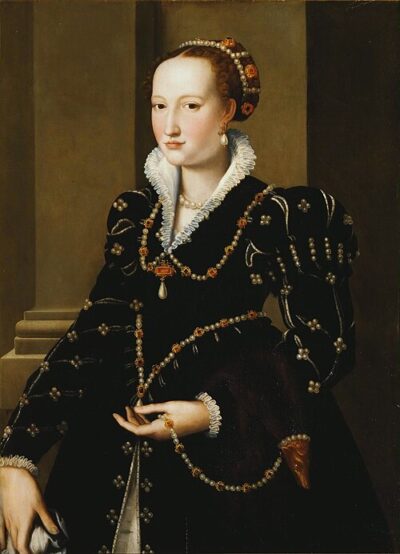
Isabella de' Medici
Isabella de' Medici was a daughter of Cosimo I. de’ Medici and Eleonora of Toledo. Born August 31, 1542, in Florence. Died July 16, 1576, in Cerreto Guidi.
Facts
22 facts · 2 confirmed by two sources · 2 cited · 18 from one source
Where this comes from
Papalocal keeps its own record. It started from these sources; what each one said is kept here as it was copied, so a change on their side never changes this page by itself. Tap one to read its version.
What Wikidata says · copied November 17, 2026 · revision 2567839058
- Described as
- daughter of Cosimo I. de’ Medici and Eleonora of Toledo (1542-1576)
- Other names
- Isabella Medici, Isabella Romola de' Medici
- Born
- August 31, 1542 · 1 reference
- Died
- July 16, 1576
- Born in
- Florence
- Died in
- Cerreto Guidi
- Buried in
- New Sacristy
- Occupation
- aristocrat
- Spouse
- Paolo Giordano I Orsini · 1 reference
- Children
- Virginio Orsini, Duke of Bracciano · 1 reference; Donna Eleonora Orsini · 1 reference
- Father
- Cosimo I de' Medici, Grand Duke of Tuscany
- Mother
- Eleanor of Toledo
- Siblings
- Lucrezia de' Medici; Bia de' Medici; Virginia de' Medici; Princess Maria de' Medici of Tuscany; Garzia de' Medici; Pietro de' Medici; Don Giovanni de' Medici; Giovanni de' Medici; Ferdinando I de' Medici; Francesco I de' Medici
- Religion
- Catholicism
- Wikipedias with a page
- 26
Wikidata item Q271831 (wikidata.org/wiki/Q271831), public domain (CC0). Copied November 17, 2026.
What Wikipedia says · copied November 17, 2026 · revision 1386310928
Princess Isabella Romola de' Medici (31 August 1542 – 16 July 1576), Duchess of Bracciano, was a Tuscan noblewoman, daughter of Cosimo I de' Medici, first Grand Duke of Tuscany, and Eleanor of Toledo. She was referred to as the Star of the House of Medici (La Stella di Casa Medici), in recognition of "her playfulness, vibrancy, often sarcastic sense of humour, sharpness and interest in a huge variety of topics - not to mention the great parties she held". Isabella de' Medici's influence on Renaissance Florence, through her patronage of the arts, political activities, and notable personal qualities, marks her as a significant figure within the Medici court of Grand Duke Cosimo I.
Educated in the humanist tradition with her siblings, including future Grand Dukes of Tuscany Francesco and Ferdinando de' Medici, Isabella de' Medici's destiny as a princess of the ruling Medici family, the first princes of Italy at the time, was to serve the family's political interests through marriage. Consequently, to secure Tuscany's southern borders through an alliance with the powerful Roman Orsini family, Isabella's father arranged her marriage to Paolo Giordano I Orsini when she was eleven years old. Unconventionally however, at her father's request, she remained in Florence after her marriage at age sixteen, a decision that granted her an unprecedented level of independence for a woman of her era.
Following her mother's death, Isabella's influence grew, and under the protection of her father, Cosimo I, she served as the primary female figure of the Medici family and the First Lady of Florence. Her prominent role was even recognised by other European courts, incl. the Vatican, during official occasions.
Following in the footsteps of her Medici ancestors, she occupied a central role within Florence's intellectual milieu, establishing a cultural circle, as well as championing the cause of female artists. Isabella's patronage extended to a wide range of artistic and intellectual figures, including writers, poets, painters, musicians, and scientists. Many dedicated their works to her, acknowledging her as a key figure in Florentine society and often portraying her in near-royal terms. This patronage fostered a vibrant intellectual and artistic environment in Florence and contributed to the revival of the city as a hub of Renaissance culture.
In an era when female patronage of the arts, beyond religious commissions, was still rather uncommon, she commissioned artworks solely for their aesthetic value. A key aspect of Isabella's contribution was her promotion of Florentine culture and its authors, including women artists, all the while spearheading initiatives alongside her father to establish vernacular Tuscan as Italy's official language. Contemporary accounts and artistic representations often idealised Isabella, comparing her to figures such as Saint Catherine of Alexandria and Minerva, emphasising her beauty, intellect, wisdom, and spirituality. Some even described her as a "new goddess," reflecting the high regard in which she was held.
Beyond the artistic sphere, Isabella also acted as a patron for women, supporting their professional endeavours and offering protection from abusive husbands, demonstrating her broader social influence.
In contrast to conventional expectations placed upon married women, Isabella de' Medici established a separate personal residence, the Villa Baroncelli (known today as Villa del Poggio Imperiale), which she held in her own name, distinct from her official marital residence in the ancestral Palazzo Medici on Via Larga. This choice not only asserted her independence but also stood as a tangible challenge to the prevailing societal norm of women being considered their husbands' property.
In 1576, two years after her father's death, Isabella died in circumstances that gave rise to widespread speculation of murder. Contemporary accounts and diplomatic dispatches suggest her husband may have been responsible, possibly with the complicity of her brother Grand Duke Francesco, in retaliation for her alleged affair with her husband's cousin, Troilo Orsini. Others suggested that Isabella's growing influence and popularity made her a potential rival to her brother Francesco, since as the mother of Cosimo I's only grandson at the time she could have served as a figurehead for opposition to his unpopular rule - a concern not unfounded in the wake of the Pucci conspiracy. However, scholar Elisabetta More argued that a literal reading of the correspondence between Isabella and her husband supports the conclusion that she died of natural causes.
Isabella had two surviving children: a daughter, Francesca Eleonora Orsini (known as Nora), and a son, Virginio Orsini. Nora would later marry her cousin Alessandro Sforza and become the Duchess of Segni and Santa Fiora, while Virginio would become the 2nd Duke of Bracciano and hailed as 'the best of the Orsini dukes'. He is believed to be the inspiration for Duke Orsino in Shakespeare's Twelfth Night.
Despite her contributions to Tuscan scholarship, arts, and politics, Isabella's legacy may have been deliberately suppressed after her untimely death. Although a prominent political figure and patron, her portraits are largely absent from family and museum collections, leading some scholars to suggest that she was subjected to damnatio memoriae, possibly orchestrated by her brother to restore family honour and posthumously diminish her influence.
After her death, Isabella remained a source of inspiration for musical and literary works. Today, each July, the village of Cerreto Guidi commemorates Isabella's life and cultural impact with a two-day festival called La notte d'Isabella (The night of Isabella).
- Born, in its opening lines
- August 31, 1542
- Died, in its opening lines
- July 16, 1576
From the Wikipedia article “Isabella de' Medici” (en.wikipedia.org/wiki/Isabella_de'_Medici), by its contributors, under CC BY-SA 4.0 (creativecommons.org/licenses/by-sa/4.0/). Copied November 17, 2026; not changed.
Confirmed Two sources agree. Cited One source, and it names where it got it. One source One source, without a reference of its own. Sources disagree The sources disagree. We show the best-supported value and keep theirs below.
