
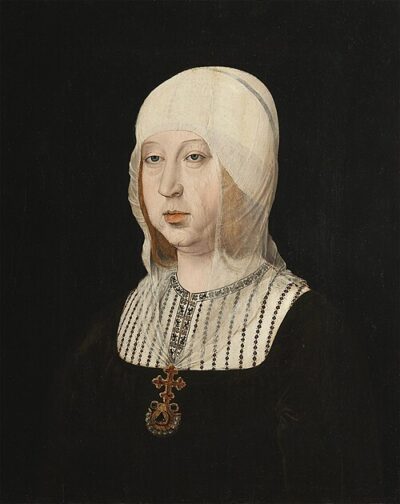
Isabella I of Castile
Isabella I of Castile was a queen of the Crown of Castile, from 1474 to 1504; first queen of a dynastically-united Spain, from 1479 to 1504. Born April 22, 1451, in Monasterio de Nuestra Señora de Gracia. Died November 26, 1504, in Palacio Testamentario. Positions held include Monarch of Castile and Leon (1474–1504), royal Consort of Aragon (1479–1504) and Lieutenant General of the States of the Crown of Aragon (1488–). Awards include Golden Rose.
Facts
28 facts · 2 confirmed by two sources · 8 cited · 17 from one source · 1 where the sources disagree
What’s different
- Buried in: we show Royal Chapel of Granada (Sources disagree). Wikidata also lists Sepulcher of Isabella I of Castile and Ferdinand II of Aragon
Where this comes from
Papalocal keeps its own record. It started from these sources; what each one said is kept here as it was copied, so a change on their side never changes this page by itself. Tap one to read its version.
What Wikidata says · copied November 16, 2026 · revision 2567791220
- Described as
- queen of the Crown of Castile, from 1474 to 1504; first queen of a dynastically-united Spain, from 1479 to 1504 (1451–1504)
- Other names
- Isabella, Isabella of Spain, Queen of Spain Isabel I, Isabella the Catholic, Isabella I of Spain, Isabel of Castile, Queen Isabella of Spain, Queen Isabella, la Católica, Queen of Spain Isabel I, Queen of Castile and Leon Isabella, Queen of Castile and León Isabella, Queen of Spain Helisaba I
- Born
- April 22, 1451 · 4 references
- Died
- November 26, 1504 · 2 references
- Born in
- Monasterio de Nuestra Señora de Gracia · 1 reference
- Died in
- Palacio Testamentario · 1 reference
- Buried in
- Royal Chapel of Granada · 1 reference; Sepulcher of Isabella I of Castile and Ferdinand II of Aragon
- Cause of death
- water retention
- Name at birth
- Isabel de Castilla
- Citizen of
- Crown of Castile
- Occupation
- ruler
- Positions held
- Monarch of Castile and Leon (1474–1504); royal Consort of Aragon (1479–1504); Lieutenant General of the States of the Crown of Aragon (1488–)
- Member of
- Catholic Monarchs
- Awards
- Golden Rose (1493)
- Spouse
- Ferdinand II of Aragon (1469–1504) · 3 references
- Children
- Isabel of Aragon · 1 reference; John, Prince of Asturias; Juana I of Castile · 1 reference; Maria of Aragon · 1 reference; Catherine of Aragon
- Father
- John II of Castile · 1 reference
- Mother
- Isabella of Portugal · 1 reference
- Siblings
- Catherine; Infanta Leonor of Castile; Henry IV of Castile; Alfonso; Infanta Maria of Castile
- Religion
- Catholicism
- Wikipedias with a page
- 104
Wikidata item Q45859 (wikidata.org/wiki/Q45859), public domain (CC0). Copied November 16, 2026.
What Wikipedia says · copied November 16, 2026 · revision 1385614638
Isabella I (Spanish: Isabel I; 22 April 1451 – 26 November 1504), also known as Isabella the Catholic (Spanish: Isabel la Católica), was Queen of Castile and León from 1474 until her death in 1504. She was also Queen of Aragon from 1479 until her death as the wife of King Ferdinand II. Reigning together over a dynastically unified Spain, Isabella and Ferdinand are known as the Catholic Monarchs. Her reign marked the end of the Reconquista and also the start of the Spanish Empire, allowing Spain to become a major force in European politics.
Isabella's marriage to Ferdinand of Aragon in 1469 created the basis of the de facto unification of Spain. With Ferdinand's help, she won the War of the Castilian Succession, securing her position as Queen of Castile. Isabella reorganized the governmental system, brought the crime rate down, and unburdened the kingdom of the debt which her half-brother King Henry IV had left behind. Her reforms and those she made with her husband had an influence that extended well beyond the borders of their united kingdoms.
Isabella and Ferdinand are known for being the first monarchs to be referred to as the queen and king of Spain, respectively. Their actions included completion of the Reconquista, the Alhambra Decree which ordered the mass expulsion of Jews from Spain, initiating the Spanish Inquisition, financing Christopher Columbus's 1492 voyage to the New World, and establishing the Spanish Empire, making Spain a major power in Europe and the world and ultimately ushering in the Spanish Golden Age.
Together with her husband, Isabella was granted the title of "Catholic Monarch" by Pope Alexander VI, a Spaniard. Her beatification process was opened in 1958, and in 1974 she was granted the title of Servant of God.
- Born, in its opening lines
- April 22, 1451
- Died, in its opening lines
- November 26, 1504
From the Wikipedia article “Isabella I of Castile” (en.wikipedia.org/wiki/Isabella_I_of_Castile), by its contributors, under CC BY-SA 4.0 (creativecommons.org/licenses/by-sa/4.0/). Copied November 16, 2026; not changed.
Confirmed Two sources agree. Cited One source, and it names where it got it. One source One source, without a reference of its own. Sources disagree The sources disagree. We show the best-supported value and keep theirs below.
