
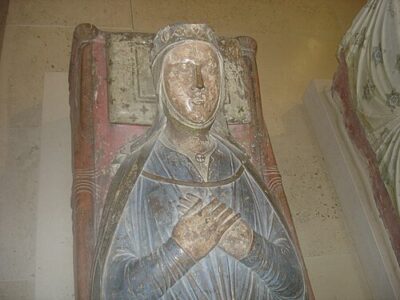
Isabella of Angoulême
Isabella of Angoulême was a Queen consort of England as the second wife of King John. Born 1188. Died May 31, 1246, in Royal abbey of Fontevraud.
Facts
23 facts · 0 confirmed by two sources · 15 cited · 7 from one source · 1 where the sources disagree
What’s different
- Died: we show May 31, 1246 (Sources disagree). Wikidata also lists June 4, 1246
Where this comes from
Papalocal keeps its own record. It started from these sources; what each one said is kept here as it was copied, so a change on their side never changes this page by itself. Tap one to read its version.
What Wikidata says · copied November 16, 2026 · revision 2523466535
- Described as
- Queen consort of England as the second wife of King John
- Other names
- Isabelle d'Angoulême, Isabella of Angouleme
- Born
- 1188; 1188 · 1 reference
- Died
- June 4, 1246; May 31, 1246 · 4 references
- Died in
- Royal abbey of Fontevraud
- Buried in
- Royal abbey of Fontevraud
- Citizen of
- France
- Occupation
- consort
- Field
- politics · 1 reference
- Spouse
- John, King of England (1200–) · 2 references; Hugh X of Lusignan · 2 references
- Children
- Henry III of England · 1 reference; Richard of Cornwall · 1 reference; Joan of England · 1 reference; Isabella of England · 1 reference; Eleanor of Leicester · 1 reference; Hugh XI of Lusignan · 1 reference; Aymer de Lusignan · 1 reference; William de Valence, 1st Earl of Pembroke · 1 reference; Isabella of Lusignan · 2 references; Alice de Lusignan, Countess of Surrey; Guy de Lusignan · 1 reference; Geoffrey I of Lusignan (Lord of Jarnac) · 2 references
- Father
- Aymer, Count of Angoulême
- Mother
- Alice of Courtenay
- Wikipedias with a page
- 39
Wikidata item Q231788 (wikidata.org/wiki/Q231788), public domain (CC0). Copied November 16, 2026.
What Wikipedia says · copied November 16, 2026 · revision 1358757938
Isabella (French: Isabelle d'Angoulême, IPA: [izabɛl dɑ̃ɡulɛm]; c. 1186/ 1188 – 4 June 1246) was Queen of England from 1200 to 1216 as the second wife of King John, Countess of Angoulême in her own right from 1202 until her death in 1246, and Countess of La Marche from 1220 to 1246 as the wife of Count Hugh.
Isabella was the only child of Aymer, Count of Angoulême, and Alice of Courtenay. In 1200, she married King John, with whom she had five children, including the future Henry III of England. After John died in 1216, Isabella remarried in 1220 to Hugh X of Lusignan, Count of La Marche, by whom she had another nine children.
Some of Isabella's contemporaries, as well as later writers, claim that she formed a conspiracy against King Louis IX of France in 1241, after being publicly snubbed by his mother, Blanche of Castile, for whom she harbored a deep-seated hatred. In 1244, after the plot had failed, Isabella was accused of attempting to poison the king. To avoid arrest, she sought refuge in Fontevraud Abbey, where she died two years later, but none of this can be confirmed.
From the Wikipedia article “Isabella of Angoulême” (en.wikipedia.org/wiki/Isabella_of_Angoulême), by its contributors, under CC BY-SA 4.0 (creativecommons.org/licenses/by-sa/4.0/). Copied November 16, 2026; not changed.
Confirmed Two sources agree. Cited One source, and it names where it got it. One source One source, without a reference of its own. Sources disagree The sources disagree. We show the best-supported value and keep theirs below.
