
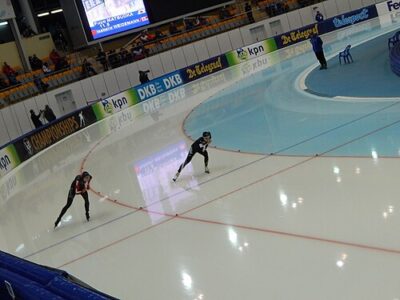
Isabelle Weidemann
Isabelle Weidemann is a Canadian speed skater. Born July 18, 1995, in Ottawa. Educated at University of Calgary.
Facts
9 facts · 1 confirmed by two sources · 7 cited · 1 from one source
Where this comes from
Papalocal keeps its own record. It started from these sources; what each one said is kept here as it was copied, so a change on their side never changes this page by itself. Tap one to read its version.
What Wikidata says · copied November 16, 2026 · revision 2519313013
- Described as
- Canadian speed skater
- Born
- July 18, 1995 · 2 references
- Born in
- Ottawa · 2 references
- Citizen of
- Canada
- Occupation
- speed skater · 2 references
- Education
- University of Calgary · 1 reference
- Sport
- speed skating · 2 references
- Lived in
- Ottawa · 1 reference; Calgary · 1 reference
- Height
- 1.88 m (6 ft 2 in) · 2 references
- Wikipedias with a page
- 23
Wikidata item Q28057538 (wikidata.org/wiki/Q28057538), public domain (CC0). Copied November 16, 2026.
What Wikipedia says · copied November 16, 2026 · revision 1364035953
Isabelle Weidemann (born July 18, 1995) is a Canadian speed skater. She is a multiple Olympic medallist, winning gold in the team pursuit, silver in the 5,000 metre, and bronze in the 3,000 metre at the 2022 Winter Olympics. She is the third Canadian long track speedskater ever to have won more than two medals at a single Winter Olympic Games following Cindy Klassen and Gaétan Boucher. She also won a gold medal in the team pursuit at the 2026 Winter Olympics in Milan. Weidemann also previously won a silver and bronze medal at the 2021 and 2020 World Single Distance Championships in women's team pursuit.
- Born, in its opening lines
- July 18, 1995
From the Wikipedia article “Isabelle Weidemann” (en.wikipedia.org/wiki/Isabelle_Weidemann), by its contributors, under CC BY-SA 4.0 (creativecommons.org/licenses/by-sa/4.0/). Copied November 16, 2026; not changed.
Confirmed Two sources agree. Cited One source, and it names where it got it. One source One source, without a reference of its own. Sources disagree The sources disagree. We show the best-supported value and keep theirs below.
