
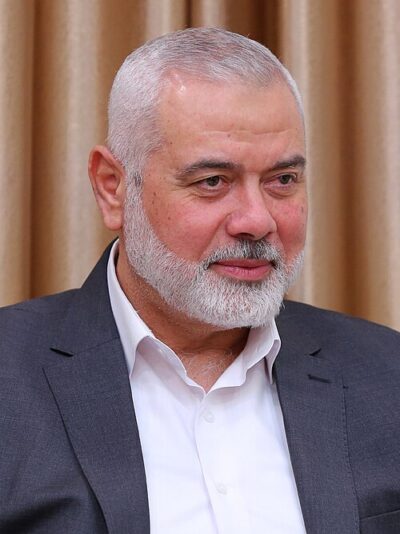
Ismail Haniyeh
Ismail Haniyeh was a Hamas leader. Born January 29, 1962, in Al-Shati refugee camp. Died July 31, 2024, in Tehran. Positions held include Prime Minister of the Palestinian National Authority (2006–2007), chief manager (2017–2024) and member of the Palestinian Legislative Council (2006–2024). Educated at Islamic University of Gaza.
Facts
23 facts · 2 confirmed by two sources · 9 cited · 12 from one source
What’s different
- Born: we show January 29, 1962 (Confirmed). Wikidata also lists January 29, 1963 and May 8, 1963
Where this comes from
Papalocal keeps its own record. It started from these sources; what each one said is kept here as it was copied, so a change on their side never changes this page by itself. Tap one to read its version.
What Wikidata says · copied November 16, 2026 · revision 2568490639
- Described as
- Hamas leader (1962–2025)
- Other names
- Ismail Haniya, Ismail Abdel Salam Ahmed Haniyeh
- Born
- January 29, 1962 · 1 reference; January 29, 1963 · 1 reference; May 8, 1963 · 1 reference
- Died
- July 31, 2024 · 3 references
- Born in
- Al-Shati refugee camp
- Died in
- Tehran · 2 references
- Buried in
- Lusail · 1 reference
- Cause of death
- bomb attack · 2 references
- Citizen of
- United Arab Republic (1962–1967); Occupied Palestinian territory (1967–1988); Palestine (1988–2024)
- Occupation
- politician · 1 reference; head of government · 1 reference
- Positions held
- Prime Minister of the Palestinian National Authority (2006–2007); chief manager (2017–2024) · 2 references; member of the Palestinian Legislative Council (2006–2024) · 1 reference
- Political party
- Hamas · 1 reference
- Education
- Islamic University of Gaza (–1987)
- Member of
- Hamas · 1 reference
- Spouse
- Amal Haniyeh (1980–2024) · 1 reference
- Children
- Abed al-Salam Haniyeh; Amir Haniyeh; Hazim Haniyeh; Mohammad Haniyeh
- Religion
- Islam
- Wikipedias with a page
- 92
Wikidata item Q152378 (wikidata.org/wiki/Q152378), public domain (CC0). Copied November 16, 2026.
What Wikipedia says · copied November 16, 2026 · revision 1370288855
Ismail Haniyeh (Arabic: إسماعيل هنية, romanized: Ismāʿīl Haniyyah, ; 29 January 1962 – 31 July 2024) was a Palestinian politician who served as third chairman of the Hamas Political Bureau from May 2017 until his assassination in July 2024. He also served as the prime minister of the Palestinian National Authority from March 2006 until June 2014 and the first Hamas leader in the Gaza Strip from June 2007 until February 2017, where he was succeeded by Yahya Sinwar.
Haniyeh was born in the al-Shati refugee camp in the then Egyptian-administered Gaza Strip in 1962 or 1963, to parents who were expelled or fled from Al-Jura (now part of Ashkelon) during the 1948 Palestine war. He earned a bachelor's degree in Arabic literature from the Islamic University of Gaza in 1987, where he first became involved with Hamas, which was formed during the First Intifada against the Israeli occupation. His involvement led to his imprisonment for three short periods after participating in protests. After his release in 1992, he was exiled to Lebanon, returning a year later to become a dean at Gaza's Islamic University. Haniyeh was appointed to head a Hamas office in 1997 and subsequently rose in the ranks of the organization.
Haniyeh was head of the Hamas list that won the Palestinian legislative elections of 2006, which campaigned on armed resistance against Israel, and so became Prime Minister of the State of Palestine. However, Mahmoud Abbas, the Palestinian president, dismissed Haniyeh from office on 14 June 2007. Due to the then-ongoing Fatah–Hamas conflict, Haniyeh did not acknowledge Abbas' decree and continued to exercise prime ministerial authority in the Gaza Strip. Haniyeh was the leader of Hamas in the Gaza Strip from 2006 until February 2017, when he was replaced by Yahya Sinwar. Haniyeh was seen by many diplomats as one of the more pragmatic and moderate figures in Hamas. From 2017 until his assassination in 2024, he had mostly lived in Qatar.
On 6 May 2017, Haniyeh was elected chairman of Hamas's Political Bureau, replacing Khaled Mashal; at the time, Haniyeh relocated from the Gaza Strip to Qatar. Under his tenure, Hamas launched the October 7 attacks, and subsequently Israel declared its intention to assassinate all Hamas leaders. In May 2024, Karim Khan, the prosecutor of the International Criminal Court, announced his intention to apply for an arrest warrant for Haniyeh, and other Hamas leaders, for war crimes and crimes against humanity, as part of the ICC investigation in Palestine. On 31 July 2024, Haniyeh was assassinated by an explosive device planted in his guesthouse in Tehran, likely by Israeli Mossad agents. At the time of his death, he had been leading cease-fire negotiations with Israel for Hamas.
- Born, in its opening lines
- January 29, 1962
- Died, in its opening lines
- July 31, 2024
From the Wikipedia article “Ismail Haniyeh” (en.wikipedia.org/wiki/Ismail_Haniyeh), by its contributors, under CC BY-SA 4.0 (creativecommons.org/licenses/by-sa/4.0/). Copied November 16, 2026; not changed.
Confirmed Two sources agree. Cited One source, and it names where it got it. One source One source, without a reference of its own. Sources disagree The sources disagree. We show the best-supported value and keep theirs below.
