
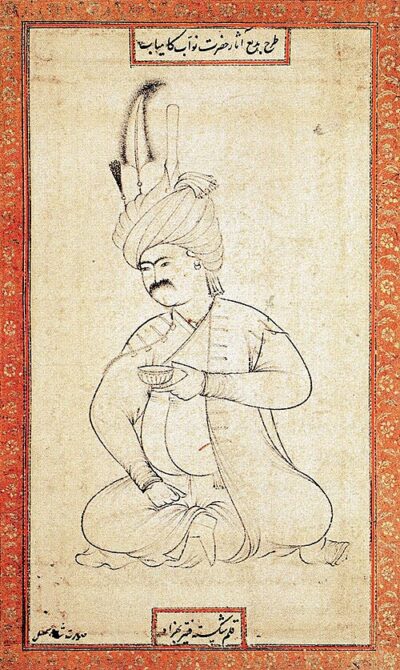
Ismail I
Ismail I was a founder and first shah of Safavid Iran. Born July 17, 1487, in Ardabil. Died May 23, 1524, in Tabriz. Positions held include list of Safavid monarchs (1501–1524). Known for Dehname.
Facts
34 facts · 2 confirmed by two sources · 11 cited · 21 from one source
Where this comes from
Papalocal keeps its own record. It started from these sources; what each one said is kept here as it was copied, so a change on their side never changes this page by itself. Tap one to read its version.
What Wikidata says · copied November 16, 2026 · revision 2567618018
- Described as
- founder and first shah of Safavid Iran
- Other names
- Ismail Safavi, Hatayi
- Born
- July 17, 1487 · 4 references
- Died
- May 23, 1524 · 3 references
- Born in
- Ardabil · 1 reference
- Died in
- Tabriz · 2 references
- Buried in
- Sheikh Safi al-Din Khānegāh and Shrine Ensemble · 1 reference
- Citizen of
- Safavid Iran
- Occupation
- governor; monarch · 1 reference; military leader · 1 reference; head of state; politician; poet; writer
- Positions held
- list of Safavid monarchs (1501–1524)
- Known for
- Dehname
- Field
- Islam · 1 reference; Shia Islam · 1 reference; Sufism · 1 reference; military affairs · 1 reference; religion in politics · 1 reference; political science
- Spouse
- Tajlu Begum (1504–1524) · 1 reference
- Children
- Tahmasp I; Elkas Mirza; Sam Mirza; Bahram Mirza · 1 reference; Parikhan Khanum (1506–1540) · 1 reference; Mahinbanu Sultan · 1 reference
- Father
- Shaykh Haydar
- Mother
- Halima Begum · 1 reference
- Siblings
- Ali Mirza Safavi
- Religion
- Islam · 1 reference; Twelver Shiism · 1 reference
- Lived in
- Hasht Behesht Palace (Tabriz) (1501–1524)
- Wikipedias with a page
- 83
Wikidata item Q214559 (wikidata.org/wiki/Q214559), public domain (CC0). Copied November 16, 2026.
What Wikipedia says · copied November 16, 2026 · revision 1385529771
Ismail I (Persian: اسماعیل یکم, romanized: Ismāʿīl; 17 July 1487 – 23 May 1524) was the founder and first shah of Safavid Iran, ruling from 1501 until his death in 1524. His reign is one of the most vital in the history of Iran, marking the beginning of Iran’s transformation from a majority Sunni Muslim country into a majority Shia Muslim state through a policy of forced conversion. The Safavid era is often considered the beginning of modern Iranian history. Under Ismail, Iran was unified under native rule for the first time since the Islamic conquest of the country eight-and-a-half centuries earlier.
Ismail inherited leadership of the Safavid Sufi order from his brother as a child. His predecessors had transformed the religious order into a military movement supported by the Qizilbash (mainly Turkoman Shiite groups). The Safavids took control of northwestern Iran, with Tabriz as the capital. In 1501, Ismail was crowned as shah (king). In the following years, Ismail conquered the rest of Iran and other neighbouring territories. His expansion into Eastern Anatolia brought him into conflict with the Ottoman Empire. In 1514, the Ottomans decisively defeated the Safavids at the Battle of Chaldiran, which brought an end to Ismail's conquests. Ismail fell into depression and heavy drinking after this defeat and died in 1524. He was succeeded by his eldest son Tahmasp I.
One of Ismail's first actions was the proclamation of the Twelver denomination of Shia Islam as the official religion of the Safavid state, marking one of the most important turning points in the history of Islam, which had major consequences for the ensuing history of Iran. He caused sectarian tensions in the Middle East when he destroyed the tombs of the Abbasid caliphs, the Sunni Imam Abu Hanifa, and the Sufi Muslim ascetic Abdul Qadir Gilani in 1508.
The dynasty founded by Ismail I would rule for over two centuries, being one of the greatest Iranian empires and at its height being amongst the most powerful empires of its time, ruling all of present-day Iran, the Republic of Azerbaijan, Armenia, most of Georgia, the North Caucasus, and Iraq, as well as parts of modern-day Turkey, Syria, Pakistan, Afghanistan, Uzbekistan, and Turkmenistan. It also reasserted Iranian identity in large parts of Greater Iran. The legacy of the Safavid Empire was also the revival of Iran as an economic stronghold between the East and the West, the establishment of a bureaucratic state, its architectural innovations, and patronage for fine arts.
Ismail I was also a prolific poet who under the pen name Khaṭāʾī (Arabic: خطائي, lit. 'the wrongful') contributed to the literary development of a southern Turkic dialect, which is often called Ajami Turkic and seen as a precursor to the Azerbaijani language. He also contributed to Persian literature, though few of his Persian writings survive.
- Born, in its opening lines
- July 17, 1487
- Died, in its opening lines
- May 23, 1524
From the Wikipedia article “Ismail I” (en.wikipedia.org/wiki/Ismail_I), by its contributors, under CC BY-SA 4.0 (creativecommons.org/licenses/by-sa/4.0/). Copied November 16, 2026; not changed.
Confirmed Two sources agree. Cited One source, and it names where it got it. One source One source, without a reference of its own. Sources disagree The sources disagree. We show the best-supported value and keep theirs below.
