
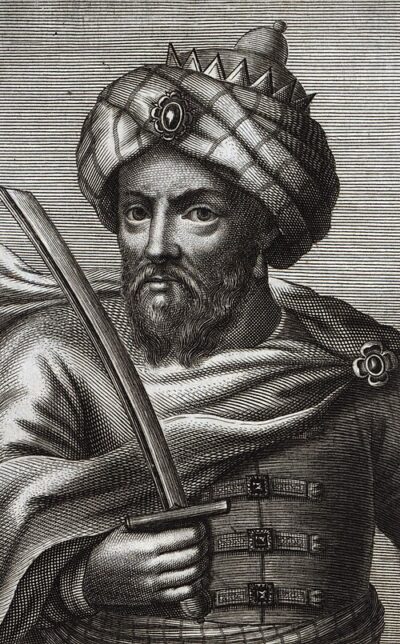
Ismail Ibn Sharif
Ismail Ibn Sharif was a Sultan of Morocco from 1672 to 1727. Born 1645, in Tafilalt. Died March 22, 1727, in Meknes. Positions held include sultan of Morocco (1672–1727).
Facts
24 facts · 2 confirmed by two sources · 0 cited · 22 from one source
Where this comes from
Papalocal keeps its own record. It started from these sources; what each one said is kept here as it was copied, so a change on their side never changes this page by itself. Tap one to read its version.
What Wikidata says · copied November 16, 2026 · revision 2568763082
- Described as
- Sultan of Morocco from 1672 to 1727
- Other names
- Heblhejr, Moulay Ismail ibn Sharif, Mawlay Ismaʿil
- Born
- 1645 · 1 reference
- Died
- March 22, 1727 · 1 reference
- Born in
- Tafilalt
- Died in
- Meknes
- Buried in
- Mausoleum of Moulay Ismail · 1 reference
- Occupation
- monarch
- Positions held
- sultan of Morocco (1672–1727)
- Spouse
- Khunathah bint Bakkar · 1 reference; Nassira el-Salwi bint Mohammed el-Heyba; Halima Al Sufyaniyah; Aouda Doukalia; Lalla Umm al-Iz at-Taba; Lalla Aisha Mubarka
- Children
- Abu'l Abbas Ahmad of Morocco; Abdalmalik of Morocco; Abdallah of Morocco; Ali of Morocco; Mohammed II of Morocco; Al-Mostadi of Morocco; Zin al-Abidin of Morocco
- Father
- Moulay Ali Cherif · 1 reference
- Siblings
- Muhammad ibn Sharif; Al-Rashid of Morocco
- Religion
- Islam
- Wikipedias with a page
- 45
Wikidata item Q276938 (wikidata.org/wiki/Q276938), public domain (CC0). Copied November 16, 2026.
What Wikipedia says · copied November 16, 2026 · revision 1383819042
Moulay Ismail Ibn Sharif (Arabic: أبو النَّصْرِ مولاي إسماعيل بن الشريف, romanized: Abu 'l-Naṣr Mawlāy Ismāʿīl ibn al-Sharīf, c. 1645 – 22 March 1727) was a Sultan of Morocco from 1672 to 1727, as the second ruler of the 'Alawi dynasty. He was the seventh son of Moulay Sharif and was governor of the province of Fez and the north of Morocco from 1667 until the death of his half-brother, Sultan Moulay Rashid in 1672. He was proclaimed sultan at Fez, but spent several years in conflict with his nephew Moulay Ahmed ben Mehrez, who also claimed the throne, until the latter's death in 1687. Moulay Ismail's 55-year reign is the longest of any sultan of Morocco. During his lifetime, Isma'il amassed a harem of over 500 women with more than 800 confirmed biological children, making him one of the most prodigious fathers in recorded history.
The reign of Moulay Ismail marked a high watermark for Moroccan power. His military successes are explained by the creation of a strong army, originally relying on the 'Guichs' (especially the Udaya) and on the Black Guard (or Abid al-Bukhari), black slaves who were totally devoted to him. As a result, the central power could be less reliant on tribes that often rebelled. Moulay Ismail failed against the Ottoman Regency of Algiers during the Battle of Moulouya in 1692, as he tried to expand his territory towards Tlemcen. Moulay Ismail once again attempted to capture Oran, which was under Spanish rule, he had some success in pushing back the tribes of the Regency of Algiers until the Algerian Bey Mustapha cooperated with the Spaniards in pushing back Moulay Ismail's army. Moulay Ismail engaged in the Maghrebi War against the Regency of Algiers, he was successful in conquering the Western Beylik, he even looted the palace of the Bey. His army was subsequently pushed back in the Battle of Chelif in 1701. He participated in other minor battles such as Laghouat in 1708 which ended successfully. He expelled the Europeans from the ports they had occupied: Larache, Asilah, Mehdya, and Tangier. He took thousands of Christians prisoner and nearly took Ceuta.
Ismail controlled a fleet of corsairs based at Salé-le-Vieux and Salé-le-Neuf (now Rabat), which supplied him with European Christian slaves and weapons through their raids in the Mediterranean and all the way to the Black Sea. He established significant diplomatic relations with foreign powers, especially the Kingdom of France, Great Britain, and Spain. Often compared to his contemporary, Louis XIV, due to his charisma and authority, Moulay Ismail was nicknamed the 'bloody king' by the Europeans due to his extreme cruelty and exaction of summary justice upon his Christian slaves. He is also known in his native country as the "Warrior King".
He also made Meknes his capital and undertook the construction of an enormous citadel and palace complex next to its old city which included several grand residences, gardens, monumental gates, mosques, and more than forty kilometers of walls. He died following a sickness. After his death, his supporters became so powerful that they controlled the country, enthroning and dethroning the sultans at will.
- Born, in its opening lines
- c. 1645
- Died, in its opening lines
- March 22, 1727
From the Wikipedia article “Ismail Ibn Sharif” (en.wikipedia.org/wiki/Ismail_Ibn_Sharif), by its contributors, under CC BY-SA 4.0 (creativecommons.org/licenses/by-sa/4.0/). Copied November 16, 2026; not changed.
Confirmed Two sources agree. Cited One source, and it names where it got it. One source One source, without a reference of its own. Sources disagree The sources disagree. We show the best-supported value and keep theirs below.
