
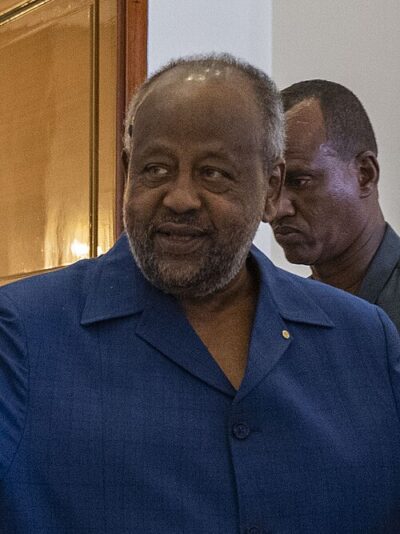
Ismail Omar Guelleh
Ismail Omar Guelleh is a President of Djibouti since 1999. Born November 27, 1947, in Dire Dawa. Positions held include President of Djibouti (1999–). Awards include Padma Vibhushan.
Facts
10 facts · 1 confirmed by two sources · 3 cited · 6 from one source
Where this comes from
Papalocal keeps its own record. It started from these sources; what each one said is kept here as it was copied, so a change on their side never changes this page by itself. Tap one to read its version.
What Wikidata says · copied November 16, 2026 · revision 2567183487
- Described as
- President of Djibouti since 1999
- Born
- November 27, 1947 · 3 references
- Born in
- Dire Dawa
- Citizen of
- France; Djibouti
- Occupation
- politician · 1 reference
- Positions held
- President of Djibouti (1999–)
- Political party
- People's Rally for Progress
- Awards
- Padma Vibhushan (2019) · 1 reference
- Spouse
- Kadra Mahamoud Haid · 1 reference
- Religion
- Sunni Islam
- Wikipedias with a page
- 61
Wikidata item Q57390 (wikidata.org/wiki/Q57390), public domain (CC0). Copied November 16, 2026.
What Wikipedia says · copied November 16, 2026 · revision 1382707613
Ismaïl Omar Guelleh (born 27 November 1947), often referred to by his initials IOG, is a Djiboutian politician who has served as the President of Djibouti since 1999.
Guelleh was first elected as President in 1999 as the handpicked successor to his uncle, Hassan Gouled Aptidon, who had ruled Djibouti since independence in 1977. Guelleh was re-elected in 2005, 2011, 2016, 2021, and 2026. The elections were largely boycotted by the opposition amid complaints over widespread irregularities. Guelleh has been characterized as a dictator, and his rule has been criticized by human rights groups and foreign governments.
- Born, in its opening lines
- November 27, 1947
From the Wikipedia article “Ismaïl Omar Guelleh” (en.wikipedia.org/wiki/Ismaïl_Omar_Guelleh), by its contributors, under CC BY-SA 4.0 (creativecommons.org/licenses/by-sa/4.0/). Copied November 16, 2026; not changed.
Confirmed Two sources agree. Cited One source, and it names where it got it. One source One source, without a reference of its own. Sources disagree The sources disagree. We show the best-supported value and keep theirs below.
