
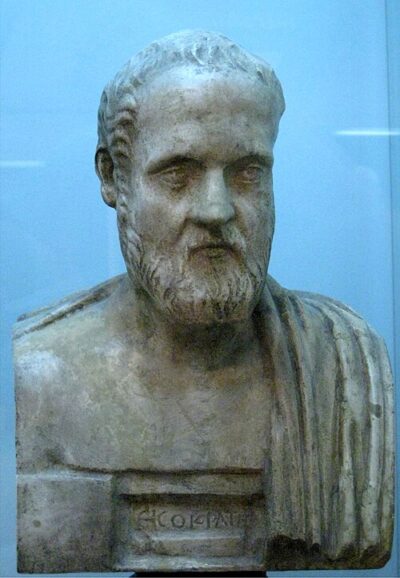
Isocrates
Isocrates was a Greek rhetorician and writer. Born 436 BC, in Classical Athens. Died August 338 BC, in Classical Athens.
Facts
9 facts · 0 confirmed by two sources · 3 cited · 4 from one source · 2 where the sources disagree
What’s different
- Born: we show 436 BC (Sources disagree). Wikipedia says 436
- Died: we show August 338 BC (Sources disagree). Wikipedia says 338
Where this comes from
Papalocal keeps its own record. It started from these sources; what each one said is kept here as it was copied, so a change on their side never changes this page by itself. Tap one to read its version.
What Wikidata says · copied November 16, 2026 · revision 2567794653
- Described as
- Greek rhetorician and writer (436–338 BC)
- Other names
- Isokratēs, Isokrates
- Born
- 436 BC · 2 references
- Died
- August 338 BC
- Born in
- Classical Athens
- Died in
- Classical Athens
- Citizen of
- Classical Athens
- Occupation
- orator · 1 reference; writer · 2 references
- Field
- philosophy
- Spouse
- Plathane · 1 reference
- Wikipedias with a page
- 74
Wikidata item Q221182 (wikidata.org/wiki/Q221182), public domain (CC0). Copied November 16, 2026.
What Wikipedia says · copied November 16, 2026 · revision 1382395940
Isocrates (; Ancient Greek: Ἰσοκράτης [isokrátɛ̂ːs]; 436–338 BC) was an ancient Greek rhetorician, one of the ten Attic orators. Among the most influential Greek rhetoricians of his time, Isocrates made many contributions to rhetoric and education through his teaching and written works.
Greek rhetoric is commonly traced to Corax of Syracuse, who first formulated a set of rhetorical rules in the fifth century BC. His pupil Tisias was influential in the development of the rhetoric of the courtroom, and by some accounts was the teacher of Isocrates. Within two generations, rhetoric had become an important art, its growth driven by social and political changes such as democracy and courts of law. Isocrates starved himself to death, reportedly out of disappointment with the loss of Greek liberty following the Battle of Chaeronea, two years before his 100th birthday.
Isocrates wrote a number of works calling on the Greeks to unite and invade the Persian empire. He addressed a number of Greek leaders asking them to undertake such a campaign, and later in his life he saw Philip II of Macedon as the ruler who could accomplish this task. He did not live to see the conquest of the Persian empire by Philip's son and successor, Alexander the Great.
- Born, in its opening lines
- 436
- Died, in its opening lines
- 338
From the Wikipedia article “Isocrates” (en.wikipedia.org/wiki/Isocrates), by its contributors, under CC BY-SA 4.0 (creativecommons.org/licenses/by-sa/4.0/). Copied November 16, 2026; not changed.
Confirmed Two sources agree. Cited One source, and it names where it got it. One source One source, without a reference of its own. Sources disagree The sources disagree. We show the best-supported value and keep theirs below.
