
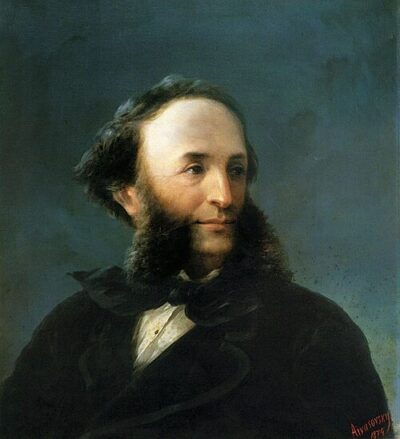
Ivan Aivazovsky
Ivan Aivazovsky was a Russian marine painter. Born July 29, 1817, in Feodosiia. Died April 19, 1900, in Feodosiia. Known for The Ninth Wave, Brig “Mercury” Attacked by Two Turkish Ships and Night at the Rodos island. Educated at Simferopol gymnasium №1 and Imperial Academy of Arts. Awards include Knight of the Legion of Honour, Order of Saint Anna, 2nd class and Order of the White Eagle.
Facts
51 facts · 1 confirmed by two sources · 24 cited · 25 from one source · 1 where the sources disagree
What’s different
- Born: we show July 29, 1817 (Confirmed). Wikidata also lists July 17, 1817
- Died: we show April 19, 1900 (Sources disagree). Wikipedia says May 2, 1900
Where this comes from
Papalocal keeps its own record. It started from these sources; what each one said is kept here as it was copied, so a change on their side never changes this page by itself. Tap one to read its version.
What Wikidata says · copied November 16, 2026 · revision 2563184642
- Described as
- Russian marine painter (1817–1900)
- Other names
- Ivan Konstantinovich Aivazovsky, Hovhannēs Ayvazyan, Ivan Konstantinovich Aiwasoffski, Ivan Konstantinovich Alwasoffski, Ivan Haivazovsky, Hovhannēs Ayvazean, Hovhannēs Kostandinian Ayvaziantsʻ, Ivan Konstantinovič Ajvazovskij, Hovhannes Aivazovsky, Hovhannēs Kostandinian Ayvazovski, Ivan Ajvazovs'kyj, İvan Konstantinoviç Ayvazovski
- Born
- July 17, 1817 · 2 references; July 29, 1817 · 1 reference
- Died
- April 19, 1900 · 6 references
- Born in
- Feodosiia · 3 references
- Died in
- Feodosiia · 3 references
- Buried in
- St. Sarkis Church (Feodosia) · 1 reference
- Name at birth
- Հովհաննես Այվազյան · 1 reference
- Citizen of
- Russian Empire
- Occupation
- painter · 2 references; visual artist · 1 reference; art collector · 1 reference
- Worked for
- Imperial Russian Navy
- Education
- Simferopol gymnasium №1 (1830–1833) · 1 reference; Imperial Academy of Arts (1833–1837) · 1 reference
- Member of
- Imperial Academy of Arts · 1 reference; Academy of Fine Arts of Rome · 1 reference; Academy of Fine Arts, Florence · 1 reference; State Academy of Fine Arts Stuttgart · 1 reference; Rijksakademie van beeldende kunsten · 1 reference; Russian Geographical Society · 1 reference; Accademia delle Arti del Disegno
- Genre
- marine art · 1 reference; landscape painting · 1 reference; military art · 1 reference; figure · 1 reference; genre painting · 1 reference; history painting · 1 reference
- Known for
- The Ninth Wave; Brig “Mercury” Attacked by Two Turkish Ships; Night at the Rodos island
- Awards
- Knight of the Legion of Honour (1857) · 1 reference; Order of Saint Anna, 2nd class; Order of the White Eagle; Order of St. Vladimir, 2nd class; Knight of the Order of St. Alexander Nevsky · 1 reference; 1st class, Order of the Medjidie · 1 reference; Large gold medal of the Imperial Academy of Arts (1837) · 1 reference; Order of St. Vladimir · 1 reference; Order of Saint Anna · 1 reference; Order of Osmanieh · 1 reference
- Field
- painting · 1 reference; visual arts · 1 reference; marine art · 1 reference
- Spouse
- Julia Graves
- Children
- Elena Aivazovskaya; Maria Aivazovskaya; Aleksandra Aivazovskaya; Zhanna Aivazovskaya
- Father
- Gevork Haivazovsky
- Siblings
- Gabriel Aivazovsky · 1 reference; Ekaterina Mazirova
- Lived in
- Feodosiia
- Wikipedias with a page
- 73
Wikidata item Q181568 (wikidata.org/wiki/Q181568), public domain (CC0). Copied November 16, 2026.
What Wikipedia says · copied November 16, 2026 · revision 1379342390
Ivan Konstantinovich Aivazovsky (Russian: Иван Константинович Айвазовский; 29 July [O.S. 17 July] 1817 – 2 May [O.S. 19 April] 1900) was a Russian Romantic painter who is considered one of the greatest masters of marine art. Baptized as Hovhannes Aivazian, he was born to Armenian parents in the Black Sea port of Feodosia in Crimea and was mostly based there.
Following his education at the Imperial Academy of Arts in Saint Petersburg, Aivazovsky traveled to Europe and lived briefly in Italy in the early 1840s. He then returned to Russia and was appointed the main painter of the Russian Navy. Aivazovsky had close ties with the military and political elite of the Russian Empire and often attended military maneuvers. He was sponsored by the state and was well-regarded during his lifetime. The saying "worthy of Aivazovsky's brush", popularized by Anton Chekhov, was used in Russia for describing something lovely. He remains highly popular in Russia in the 21st century.
One of the most prominent Russian artists of his time, Aivazovsky was also popular outside the Russian Empire. He held numerous solo exhibitions in Europe and the United States. During his almost 60-year career, he created around 6,000 paintings, making him one of the most prolific artists of his time. The vast majority of his works are seascapes, but he often depicted battle scenes, Armenian themes, and portraiture. Most of Aivazovsky's works are kept in Russian, Ukrainian, Armenian, and Turkish museums as well as private collections.
- Born, in its opening lines
- July 29, 1817
- Died, in its opening lines
- May 2, 1900
From the Wikipedia article “Ivan Aivazovsky” (en.wikipedia.org/wiki/Ivan_Aivazovsky), by its contributors, under CC BY-SA 4.0 (creativecommons.org/licenses/by-sa/4.0/). Copied November 16, 2026; not changed.
Confirmed Two sources agree. Cited One source, and it names where it got it. One source One source, without a reference of its own. Sources disagree The sources disagree. We show the best-supported value and keep theirs below.
