
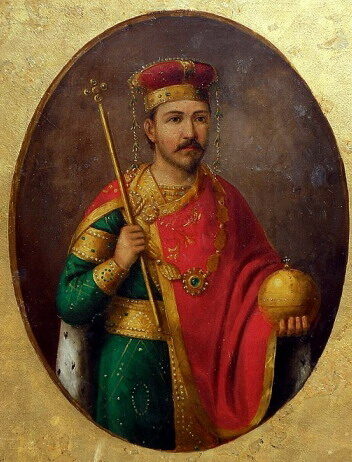
Ivan Asen II of Bulgaria was a Bulgarian ruler. Born 1190. Died June 24, 1241, in Veliko Tarnovo. Positions held include King of Bulgaria (1218–1241).
Facts
22 facts · 0 confirmed by two sources · 1 cited · 21 from one source
Where this comes from
Papalocal keeps its own record. It started from these sources; what each one said is kept here as it was copied, so a change on their side never changes this page by itself. Tap one to read its version.
What Wikidata says · copied November 16, 2026 · revision 2553957242
- Described as
- Bulgarian ruler
- Born
- 1190 · 1 reference
- Died
- June 24, 1241
- Died in
- Veliko Tarnovo · 1 reference
- Buried in
- Veliko Tarnovo
- Citizen of
- Second Bulgarian Empire
- Occupation
- sovereign
- Positions held
- King of Bulgaria (1218–1241)
- Spouse
- Anna Maria of Hungary (1221–) · 1 reference; Irene Komnene Doukaina · 2 references; Anna · 1 reference
- Children
- Maria Asanina Komnene; Beloslava of Bulgaria; Tamar Asenina; Elena Asenina of Bulgaria; Kaliman I of Bulgaria; Michael II Asen; Maria Asenina of Bulgaria; Anna-Theodora Asenina of Bulgaria
- Father
- Ivan Asen I of Bulgaria
- Mother
- Elena-Evgenia of Bulgaria
- Siblings
- Alexander Asen · 1 reference
- Religion
- Eastern Orthodoxy
- Wikipedias with a page
- 37
Wikidata item Q313427 (wikidata.org/wiki/Q313427), public domain (CC0). Copied November 16, 2026.
What Wikipedia says · copied November 16, 2026 · revision 1383068812
Ivan Asen II, also known as John Asen II (Bulgarian: Иван Асен II, [iˈvan ɐˈsɛn ˈftɔri]; 1190s – May/June 1241), was Emperor (Tsar) of Bulgaria from 1218 to 1241. He was still a child when his father Ivan Asen I – one of the founders of the Second Bulgarian Empire – was killed in 1196. His supporters tried to secure the throne for him after his uncle, Kaloyan, was murdered in 1207, but Kaloyan's other nephew, Boril, overcame them. Ivan Asen fled from Bulgaria and settled in the Rus' principalities.
Boril could never strengthen his rule which enabled Ivan Asen to muster an army and return to Bulgaria. He captured Tarnovo and blinded Boril in 1218. Initially, he supported the full communion of the Bulgarian Church with the Papacy and concluded alliances with the neighboring Catholic powers, Hungary and the Latin Empire of Constantinople. He tried to achieve the regency for the 11-year-old Latin Emperor, Baldwin II, after 1228, but the Latin aristocrats did not support Ivan Asen. He inflicted a crushing defeat on Theodore Komnenos Doukas of the Empire of Thessalonica, in the Battle of Klokotnitsa in 1230. Theodore's empire soon collapsed and Ivan Asen conquered large territories in Macedonia, Thessaly and Thrace.
The control of the trade on the Via Egnatia enabled Ivan Asen to implement an ambitious building program in Tarnovo and struck gold coins in his new mint in Ohrid. He started negotiations about the return of the Bulgarian Church to Orthodoxy after the barons of the Latin Empire had elected John of Brienne regent for Baldwin II in 1229. Ivan Asen and the Emperor of Nicaea, John III Vatatzes, concluded an alliance against the Latin Empire at their meeting in 1235. During the same conference, the rank of patriarch was granted to the head of the Bulgarian Church in token of its autocephaly (independence). Ivan Asen and Vatatzes joined their forces in attacking Constantinople, but the former realized that Vatatzes could primarily take advantage of the fall of the Latin Empire and broke off his alliance with Nicaea in 1237. After the Mongols invaded the Pontic steppes, several Cuman groups fled to Bulgaria.
From the Wikipedia article “Ivan Asen II” (en.wikipedia.org/wiki/Ivan_Asen_II), by its contributors, under CC BY-SA 4.0 (creativecommons.org/licenses/by-sa/4.0/). Copied November 16, 2026; not changed.
Confirmed Two sources agree. Cited One source, and it names where it got it. One source One source, without a reference of its own. Sources disagree The sources disagree. We show the best-supported value and keep theirs below.
