
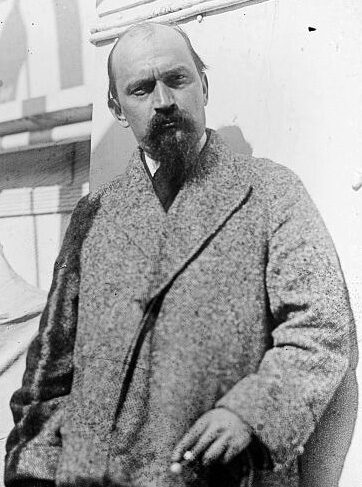
Ivan Meštrović
Ivan Meštrović was a Croatian sculptor and architect. Born August 15, 1883, in Vrpolje. Died January 16, 1962, in South Bend. Known for Pobednik, St. Jerome the Priest and Immigrant Mother. Educated at Academy of Fine Arts Vienna. Awards include Austrian Decoration for Science and Art.
Facts
35 facts · 2 confirmed by two sources · 9 cited · 24 from one source
Where this comes from
Papalocal keeps its own record. It started from these sources; what each one said is kept here as it was copied, so a change on their side never changes this page by itself. Tap one to read its version.
What Wikidata says · copied November 15, 2026 · revision 2565964981
- Described as
- Croatian sculptor and architect (1883–1962)
- Other names
- Ivan Meštrovic, Ivan Mechtrovitch, Ivan Mestrovic, Iwan Mesjtrowietsj, Iwan Mesjtrowitsj, Mestro, Ivan Meštrović Gabrilović
- Born
- August 15, 1883 · 15 references
- Died
- January 16, 1962 · 3 references
- Born in
- Vrpolje
- Died in
- South Bend · 2 references
- Buried in
- Holy Redeemer Church
- Citizen of
- Cisleithania; Kingdom of Serbs, Croats and Slovenes; Kingdom of Yugoslavia; United States
- Occupation
- sculptor · 1 reference; architect · 1 reference; university teacher; teacher · 1 reference; writer · 1 reference
- Worked for
- University of Notre Dame; Syracuse University
- Education
- Academy of Fine Arts Vienna
- Member of
- Serbian Academy of Sciences and Arts (1912–); American Academy of Arts and Letters; Romanian Academy
- Known for
- Pobednik; St. Jerome the Priest; Immigrant Mother; Monument to the Unknown Hero; Meštrović Pavilion
- Awards
- Austrian Decoration for Science and Art (1961)
- Field
- art of sculpture · 1 reference; architecture · 1 reference; creative and professional writing · 1 reference
- Spouse
- Ruža Meštrović · 1 reference
- Children
- Mate Meštrović
- Lived in
- Belgrade; Zagreb; Vienna
- Website
- http://www.mdc.hr/mestrovic
- Wikipedias with a page
- 31
Wikidata item Q313828 (wikidata.org/wiki/Q313828), public domain (CC0). Copied November 15, 2026.
What Wikipedia says · copied November 15, 2026 · revision 1372506243
Ivan Meštrović (Croatian: [ǐʋan mɛ̂ʃtrɔʋit͡ɕ] ; 15 August 1883 – 16 January 1962) was a Croatian sculptor, architect, and writer. He was the most prominent modern Croatian sculptor and a leading artistic personality in contemporary Zagreb. He studied at Pavao Bilinić's Stone Workshop in Split and at the Academy of Fine Arts Vienna, where he was formed under the influence of the Secession. He traveled throughout Europe and studied the works of ancient and Renaissance masters, especially Michelangelo, and French sculptors Auguste Rodin, Antoine Bourdelle and Aristide Maillol. He was the initiator of the national-romantic group Medulić (he advocated the creation of art of national features inspired by the heroic folk songs). During the First World War, he lived in emigration. After the war, he returned to Croatia and began a long and fruitful period of sculpture and pedagogical work. In 1942 he emigrated to Italy, in 1943 to Switzerland and in 1947 to the United States. He was a professor of sculpture at Syracuse University and from 1955 at the University of Notre Dame in South Bend, Indiana.
Most of his early works of symbolic themes were formed in the spirit of the Secession, some of which, like the Well of Life, show impressionist restless surfaces created under the influence of Rodin's naturalism, and the second, reviving national myth, become stylized monumental plastics (Kosovo cycle, 1908-1910). Before the First World War, he left pathetic epic stylization, expressing increasingly emotional states, as evidenced by the wooden reliefs of biblical themes made in a combination of Archaic, Gothic, Secessionist and Expressionist styles. During the 1920s and 1930s, the classical component prevailed in his works. In this period, he created a number of public monuments of strong plastic expression, pronounced and legible shapes (Gregory of Nin and Marko Marulić in Split, Andrija Medulić, Andrija Kačić-Miošić and Josip Juraj Strossmayer in Zagreb, Pobednik in Belgrade, Svetozar Miletić in Novi Sad and The Bowman and The Spearman in Chicago). Portraits take a special place in his opus.
Meštrović achieved works of strong plastic value in the construction-sculptural monuments and projects, mostly with central layout (the Mausoleum of the Račić family in Cavtat, the Mausoleum of the Meštrović family in Otavice, the Meštrović Pavilion in Zagreb, Monument to the Unknown Hero in Belgrade). He also designed a memorial church of King Zvonimir in Biskupija near Knin inspired by old Croatian churches, a representative family palace, today the Ivan Meštrović Gallery, and reconstructed renaissance fortified mansion Crikvine-Kaštilac in Split.
- Born, in its opening lines
- August 15, 1883
- Died, in its opening lines
- January 16, 1962
From the Wikipedia article “Ivan Meštrović” (en.wikipedia.org/wiki/Ivan_Meštrović), by its contributors, under CC BY-SA 4.0 (creativecommons.org/licenses/by-sa/4.0/). Copied November 15, 2026; not changed.
Confirmed Two sources agree. Cited One source, and it names where it got it. One source One source, without a reference of its own. Sources disagree The sources disagree. We show the best-supported value and keep theirs below.
