
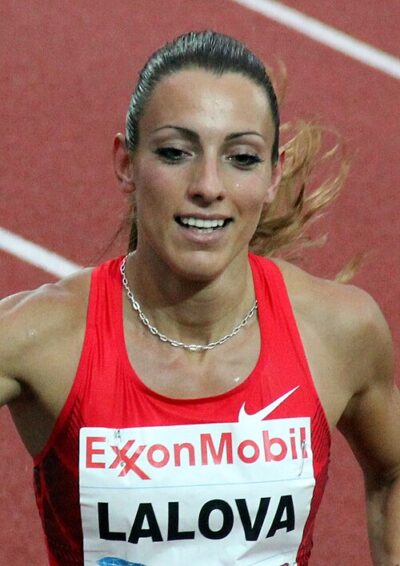
Ivet Lalova-Collio is a Bulgarian sprinter. Born May 18, 1984, in Sofia.
Facts
9 facts · 1 confirmed by two sources · 1 cited · 7 from one source
Where this comes from
Papalocal keeps its own record. It started from these sources; what each one said is kept here as it was copied, so a change on their side never changes this page by itself. Tap one to read its version.
What Wikidata says · copied November 17, 2026 · revision 2553593707
- Described as
- Bulgarian sprinter
- Other names
- Ivet Lalova, Ivet Miroslavova Lalova-Collio
- Born
- May 18, 1984 · 1 reference
- Born in
- Sofia
- Citizen of
- Bulgaria
- Occupation
- sprinter; athletics competitor · 1 reference
- Sport
- athletics
- Spouse
- Simone Collio
- Height
- 1.66 m (5 ft 5 in)
- Website
- http://www.ivetlalova.com/
- Wikipedias with a page
- 28
Wikidata item Q233308 (wikidata.org/wiki/Q233308), public domain (CC0). Copied November 17, 2026.
What Wikipedia says · copied November 17, 2026 · revision 1381199528
Ivet Miroslavova Lalova-Collio, née Lalova, (Bulgarian: Ивет Мирославова Лалова-Колио; born 18 May 1984, in Sofia) is a retired Bulgarian athlete who specialised in the 100 metres and 200 metres sprint events. She is the 13th-fastest woman in the history of the 100 metres. She finished fourth in the 100 metres and fifth in the 200 metres at the 2004 Summer Olympics. Her career was interrupted for two years between June 2005 and May 2007 due to a leg injury sustained in a collision with another athlete. In June 2012 she won gold at the 2012 European Athletics Championships in the Women's 100 metres. In July 2016 she won two silver medals at the 2016 European Athletics Championships in both the Women's 100 and 200 metres. She has participated in five editions of the Olympic Games.
- Born, in its opening lines
- May 18, 1984
From the Wikipedia article “Ivet Lalova-Collio” (en.wikipedia.org/wiki/Ivet_Lalova-Collio), by its contributors, under CC BY-SA 4.0 (creativecommons.org/licenses/by-sa/4.0/). Copied November 17, 2026; not changed.
Confirmed Two sources agree. Cited One source, and it names where it got it. One source One source, without a reference of its own. Sources disagree The sources disagree. We show the best-supported value and keep theirs below.
