
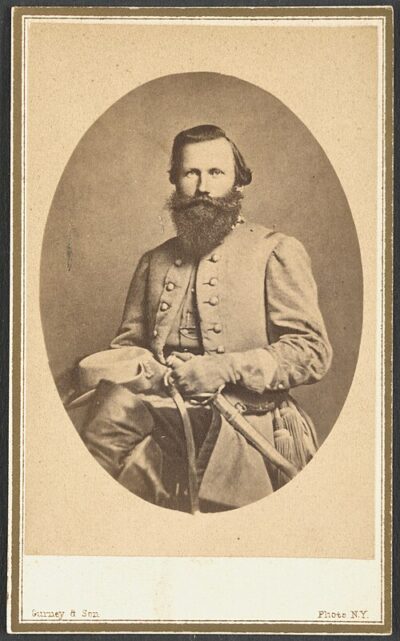
J. E. B. Stuart
J. E. B. Stuart was a Confederate cavalry general. Born February 6, 1833, in Laurel Hill Farm. Died May 12, 1864, in Richmond. Positions held include member of the Virginia House of Delegates. Educated at United States Military Academy.
Facts
20 facts · 2 confirmed by two sources · 4 cited · 14 from one source
Where this comes from
Papalocal keeps its own record. It started from these sources; what each one said is kept here as it was copied, so a change on their side never changes this page by itself. Tap one to read its version.
What Wikidata says · copied November 15, 2026 · revision 2567382159
- Described as
- Confederate cavalry general (1833–1864)
- Other names
- James Ewell Brown "Jeb" Stuart
- Born
- February 6, 1833 · 4 references
- Died
- May 12, 1864 · 4 references
- Born in
- Laurel Hill Farm
- Died in
- Richmond · 1 reference
- Buried in
- Hollywood Cemetery · 1 reference
- Cause of death
- gunshot wound
- Citizen of
- United States
- Occupation
- politician; military officer; major general · 1 reference
- Positions held
- member of the Virginia House of Delegates
- Education
- United States Military Academy · 1 reference
- Spouse
- Flora Cooke Stuart
- Father
- Archibald Stuart
- Mother
- Elizabeth Letcher Pannill · 1 reference
- Military branch
- Confederate States Army; United States Army; cavalry
- Military rank
- major general
- Nickname
- J. E. B. Stuart
- Wikipedias with a page
- 33
Wikidata item Q313583 (wikidata.org/wiki/Q313583), public domain (CC0). Copied November 15, 2026.
What Wikipedia says · copied November 15, 2026 · revision 1379806274
James Ewell Brown "Jeb" Stuart (February 6, 1833 – May 12, 1864) was a Confederate cavalry general during the American Civil War. He was known to his friends as "Jeb", from the initials of his given names. Stuart was a cavalry commander known for his mastery of reconnaissance and the use of cavalry in support of offensive operations. While he cultivated a cavalier image (red-lined gray cape, the yellow waist sash of a regular cavalry officer, hat cocked to the side with an ostrich plume, red flower in his lapel, often sporting cologne), his serious work made him the trusted eyes and ears of Robert E. Lee's army and inspired Southern morale.
Stuart graduated from West Point in 1854 and served in Texas and Kansas with the U.S. Army. Stuart was a veteran of the frontier conflicts with Native Americans and the violence of Bleeding Kansas, and he participated in the capture of John Brown at Harpers Ferry. He resigned his commission when his home state of Virginia seceded, to serve in the Confederate Army, first under Stonewall Jackson in the Shenandoah Valley, but then in increasingly important cavalry commands of the Army of Northern Virginia, playing a role in all of that army's campaigns until his death.
He established a reputation as an audacious cavalry commander and on two occasions (during the Peninsula campaign and the Maryland campaign) circumnavigated the Union Army of the Potomac, bringing fame to himself and embarrassment to the North. At the Battle of Chancellorsville, he distinguished himself as a temporary commander of the wounded Stonewall Jackson's infantry corps.
Stuart's most famous campaign, the Gettysburg campaign, was flawed when his long separation from Lee's army left Lee unaware of Union troop movements so that Lee was surprised and almost trapped at the Battle of Gettysburg. Stuart received criticism from the Southern press as well as the proponents of the Lost Cause movement after the war. During the 1864 Overland Campaign, Union Maj. Gen. Philip Sheridan's cavalry launched an offensive to defeat Stuart, who was mortally wounded at the Battle of Yellow Tavern.
- Born, in its opening lines
- February 6, 1833
- Died, in its opening lines
- May 12, 1864
From the Wikipedia article “J. E. B. Stuart” (en.wikipedia.org/wiki/J._E._B._Stuart), by its contributors, under CC BY-SA 4.0 (creativecommons.org/licenses/by-sa/4.0/). Copied November 15, 2026; not changed.
Confirmed Two sources agree. Cited One source, and it names where it got it. One source One source, without a reference of its own. Sources disagree The sources disagree. We show the best-supported value and keep theirs below.
