
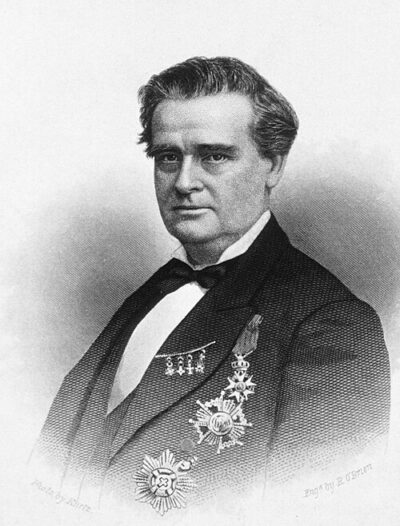
J. Marion Sims
J. Marion Sims was an American physician and gynecologist. Born January 25, 1813, in Lancaster County. Died November 13, 1883, in Manhattan. Positions held include President of the American Medical Association (1876–1877). Educated at Thomas Jefferson University and University of South Carolina.
Facts
16 facts · 2 confirmed by two sources · 4 cited · 10 from one source
Where this comes from
Papalocal keeps its own record. It started from these sources; what each one said is kept here as it was copied, so a change on their side never changes this page by itself. Tap one to read its version.
What Wikidata says · copied November 18, 2026 · revision 2567454435
- Described as
- American physician and gynecologist (1813-1883)
- Other names
- James Marion Sims, Marion Sims
- Born
- January 25, 1813 · 4 references
- Died
- November 13, 1883 · 4 references
- Born in
- Lancaster County
- Died in
- Manhattan
- Buried in
- Green-Wood Cemetery · 1 reference
- Cause of death
- myocardial infarction
- Name at birth
- James Marion Sims
- Citizen of
- United States
- Occupation
- surgeon; gynecologist · 1 reference; physician · 2 references
- Positions held
- President of the American Medical Association (1876–1877)
- Education
- Thomas Jefferson University (–1835) · 1 reference; University of South Carolina · 1 reference
- Children
- H. Marion-Sims; Florence Nightingale Sims
- Wikipedias with a page
- 18
Wikidata item Q2058137 (wikidata.org/wiki/Q2058137), public domain (CC0). Copied November 18, 2026.
What Wikipedia says · copied November 18, 2026 · revision 1376007190
James Marion Sims (January 25, 1813 – November 13, 1883) was an American medical doctor in the field of surgery. His most famous work was the development of a surgical technique for the repair of vesicovaginal fistula, a severe complication of obstructed childbirth. He developed this technique via non-consensual and unanesthetized surgeries on enslaved black women Anarcha Westcott, Lucy and Betsey and impoverished Irish women.
He is also remembered for inventing the Sims speculum, the Sims sigmoid catheter, and Sims' position. Against significant opposition, he established, in New York, the first hospital in the United States specifically for women. He was forced out of the hospital he founded because he insisted on treating cancer patients; he played a small role in the creation of the nation's first cancer hospital, which opened after his death.
Sims was one of the most famous and admired American physicians of his era. He was elected President of the American Medical Association in 1876, and he was one of the first American physicians to become famous in Europe. He openly boasted that he was the second-wealthiest doctor in the country. However, as medical ethicist Barron H. Lerner states, "one would be hard pressed to find a more controversial figure in the history of medicine." A statue in his honor was erected in 1894 in New York City's Bryant Park, the first statue in the United States in honor of a physician. It stood for 124 years before being removed in 2018.
Today, many medical ethicists criticize how Sims developed his surgical techniques. He operated on some enslaved black women and girls who, like prisoners, could not meaningfully consent because they could not refuse. During the 20th century, his experiments began to be condemned as an improper use of human experimental subjects. Sims has been described as "a prime example of progress in the medical profession made at the expense of a vulnerable population". Some medical historians have defended Sims' practices as consistent with the accepted standards of his time. According to Sims, the enslaved black women upon whom he experimented were "willing" patients who had no better options for treatment.
Sims was a prolific writer and his published reports on his medical experiments, together with his own 471-page autobiography (summarized in an address just after his death), are the main sources of knowledge about him and his career. His positive self-presentation has, in the late twentieth and early twenty-first centuries, been subject to revision.
- Born, in its opening lines
- January 25, 1813
- Died, in its opening lines
- November 13, 1883
From the Wikipedia article “J. Marion Sims” (en.wikipedia.org/wiki/J._Marion_Sims), by its contributors, under CC BY-SA 4.0 (creativecommons.org/licenses/by-sa/4.0/). Copied November 18, 2026; not changed.
Confirmed Two sources agree. Cited One source, and it names where it got it. One source One source, without a reference of its own. Sources disagree The sources disagree. We show the best-supported value and keep theirs below.
