
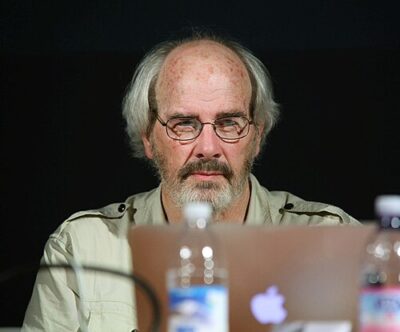
Jack Horner
Jack Horner is an American paleontologist (born 1946 ). Born June 15, 1946, in Shelby. Educated at University of Montana. Awards include MacArthur Fellows Program and Romer-Simpson Medal.
Facts
17 facts · 1 confirmed by two sources · 4 cited · 12 from one source
Where this comes from
Papalocal keeps its own record. It started from these sources; what each one said is kept here as it was copied, so a change on their side never changes this page by itself. Tap one to read its version.
What Wikidata says · copied November 15, 2026 · revision 2523677404
- Described as
- American paleontologist (born 1946 )
- Other names
- Jack Robert Horner, John Robert Horner, John R. Horner, John Horner, J. R. Horner, J.R. Horner
- Born
- June 15, 1946 · 2 references
- Born in
- Shelby
- Citizen of
- United States
- Occupation
- geologist; paleontologist · 1 reference; herpetologist; university teacher · 1 reference
- Worked for
- Montana State University; University of Montana; Museum of the Rockies
- Education
- University of Montana
- Awards
- MacArthur Fellows Program · 1 reference; Romer-Simpson Medal (2013)
- Field
- paleontology · 1 reference; dinosaur resurrection; dinosaur · 1 reference
- Website
- https://www.museumoftherockies.org
- Wikipedias with a page
- 26
Wikidata item Q247264 (wikidata.org/wiki/Q247264), public domain (CC0). Copied November 15, 2026.
What Wikipedia says · copied November 15, 2026 · revision 1383235212
John Robert Horner (born June 15, 1946) is an American paleontologist best known for his research on dinosaurs. Horner has made a career as a researcher and teacher, having worked at various scientific institutions regardless of an initial lack of a university-level degree. In 1979, Horner and fellow paleontologist Bob Makela described for the first time the duck-billed dinosaur Maiasaura. Their research on Maiasaura provided the first clear evidence that some non-avian dinosaurs cared for their young.
Horner has gained popularity among the public as a figure of authority within the field of paleontology, he has published over 100 professional papers, has authored 12 books, numerous articles, and featured in numerous documentaries. He has raised controversy too, leading him, twice in his life, to depart prestigious scientific institutions. In particular, in 2016, he quit (and retired from) the Montana State University and the Museum of the Rockies after having married in 2012, when he was 65, a 19-year old undergraduate student, 46 years his junior, and in 2026 he quit his employment at Chapman University when early that same year it was publicly unveiled that he was mentioned in the Epstein files.
Horner served as the technical advisor for the first five Jurassic Park films, which greatly contributed to increase his popularity. He served as a partial inspiration for one of the lead characters of the Jurassic Park franchise (Dr. Alan Grant), and he even had a cameo appearance in one of the franchise's films, Jurassic World, in 2015.
- Born, in its opening lines
- June 15, 1946
From the Wikipedia article “Jack Horner (paleontologist)” (en.wikipedia.org/wiki/Jack_Horner_(paleontologist)), by its contributors, under CC BY-SA 4.0 (creativecommons.org/licenses/by-sa/4.0/). Copied November 15, 2026; not changed.
Confirmed Two sources agree. Cited One source, and it names where it got it. One source One source, without a reference of its own. Sources disagree The sources disagree. We show the best-supported value and keep theirs below.
