
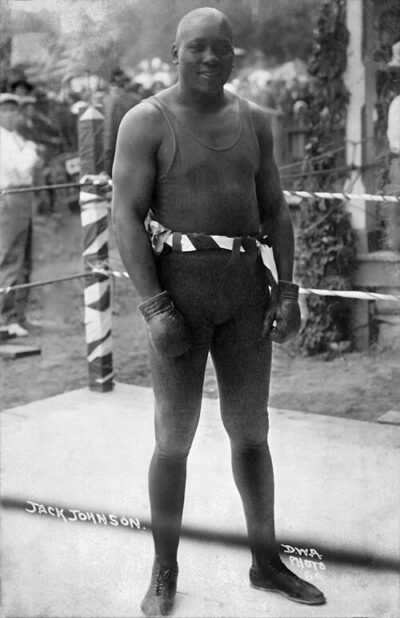
Jack Johnson
Jack Johnson was an American boxer. Born March 31, 1878, in Galveston. Died June 10, 1946, in Franklinton. Awards include Anisfield-Wolf Book Awards and International Boxing Hall of Fame.
Facts
14 facts · 2 confirmed by two sources · 2 cited · 10 from one source
Where this comes from
Papalocal keeps its own record. It started from these sources; what each one said is kept here as it was copied, so a change on their side never changes this page by itself. Tap one to read its version.
What Wikidata says · copied November 14, 2026 · revision 2557940658
- Described as
- American boxer (1878–1946)
- Other names
- John Johnson, John Arthur Johnson, Galveston Giant, Black Jack Johnson
- Born
- March 31, 1878 · 4 references
- Died
- June 10, 1946 · 4 references
- Born in
- Galveston
- Died in
- Franklinton
- Buried in
- Graceland Cemetery · 1 reference
- Cause of death
- traffic collision
- Citizen of
- United States
- Occupation
- boxer · 1 reference
- Sport
- boxing · 1 reference
- Record label
- Ajax Records
- Awards
- Anisfield-Wolf Book Awards (2005); International Boxing Hall of Fame (1990) · 1 reference
- Spouse
- Etta Terry
- Height
- 1.84 m (6 ft 1 in)
- Wikipedias with a page
- 40
Wikidata item Q316689 (wikidata.org/wiki/Q316689), public domain (CC0). Copied November 14, 2026.
What Wikipedia says · copied November 14, 2026 · revision 1385347482
John Arthur Johnson (March 31, 1878 – June 10, 1946), nicknamed the "Galveston Giant", was an American boxer who, at the height of the Jim Crow era, became the first black world heavyweight boxing champion (1908–1915). His 1910 fight against James J. Jeffries was dubbed the "fight of the century". Johnson defeated Jeffries, who was white, triggering dozens of race riots across the U.S. According to filmmaker Ken Burns, "for more than thirteen years, Jack Johnson was the most famous and the most notorious African American on Earth". He is widely regarded as one of the most influential boxers in history.
In 1912, Johnson opened a successful and luxurious "black and tan" (desegregated) restaurant and nightclub in Chicago, which in part was run by his wife, a white woman. Major newspapers of the time soon claimed that Johnson was attacked by the federal government only after he became famous as a black man married to a white woman, and was linked to other white women. Johnson was arrested on charges of violating the federal Mann Act—forbidding one to transport a woman across state lines for "immoral purposes"—a racially motivated charge that embroiled him in controversy for his relationships, including marriages. Sentenced to a year in prison, Johnson fled the country and fought boxing matches abroad for seven years until 1920, when he served his sentence at the federal penitentiary at Leavenworth.
Johnson continued taking paying fights for many years, and operated several other businesses, including lucrative endorsement deals. He died in a car crash in 1946 at the age of 68. In 2018, Johnson was posthumously pardoned by U.S. President Donald Trump.
- Born, in its opening lines
- March 31, 1878
- Died, in its opening lines
- June 10, 1946
From the Wikipedia article “Jack Johnson” (en.wikipedia.org/wiki/Jack_Johnson), by its contributors, under CC BY-SA 4.0 (creativecommons.org/licenses/by-sa/4.0/). Copied November 14, 2026; not changed.
Confirmed Two sources agree. Cited One source, and it names where it got it. One source One source, without a reference of its own. Sources disagree The sources disagree. We show the best-supported value and keep theirs below.
