
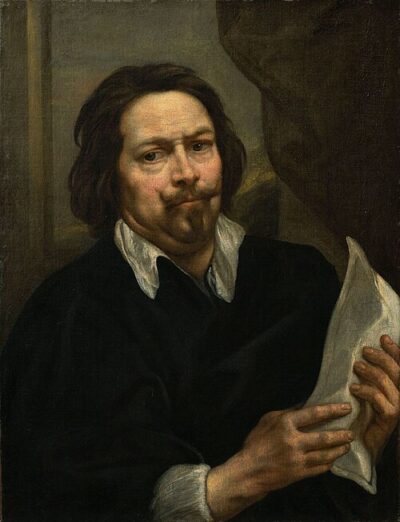
Jacob Jordaens
Jacob Jordaens was a Flemish painter, draftsman and designer of prints and tapestries. Born May 19, 1593, in Antwerp. Died October 18, 1678, in Antwerp. Known for The Abduction of Europa, Prometheus Bound and Mercury and Argus.
Facts
25 facts · 2 confirmed by two sources · 12 cited · 11 from one source
Where this comes from
Papalocal keeps its own record. It started from these sources; what each one said is kept here as it was copied, so a change on their side never changes this page by itself. Tap one to read its version.
What Wikidata says · copied November 16, 2026 · revision 2564809148
- Described as
- Flemish painter, draftsman and designer of prints and tapestries (1593-1678)
- Other names
- Jacob Jordaens (I), Jacob (I) Jordaens, Jacques Jordaens, Jacob Jordaens the Elder, P. Jordaens, Jacob Jourdains, Jacob Jordaan, Jacob Jordanes, I︠A︡kob Iordans, Jacob Jordaen, Jacob Jourdano, Giordano d'Olanda
- Born
- May 19, 1593 · 10 references
- Died
- October 18, 1678 · 12 references
- Born in
- Antwerp · 3 references
- Died in
- Antwerp · 3 references
- Name at birth
- Jacob Jordaens · 1 reference
- Citizen of
- Spanish Netherlands
- Occupation
- painter · 2 references; draftsperson · 2 references; printmaker · 1 reference
- Member of
- Antwerp Guild of Saint Luke
- Genre
- portrait · 1 reference; history painting · 1 reference; religious painting · 1 reference; mythological painting · 1 reference; genre painting · 1 reference; landscape painting · 1 reference
- Known for
- The Abduction of Europa; Prometheus Bound; Mercury and Argus; The Bagpipe Player
- Spouse
- Catharina van Noort
- Children
- Jacob Jordaens (II) · 1 reference; Elisabeth Jordaens; Anna Catharina Jordaens
- Religion
- Protestantism
- Wikipedias with a page
- 44
Wikidata item Q270658 (wikidata.org/wiki/Q270658), public domain (CC0). Copied November 16, 2026.
What Wikipedia says · copied November 16, 2026 · revision 1368048914
Jacques "Jacob" Jordaens (19 May 1593 – 18 October 1678) was a Flemish painter, draughtsman and a designer of tapestries and prints. He was a prolific artist who created biblical, mythological, and allegorical compositions, genre scenes, landscapes, illustrations of Flemish sayings and portraits. After the death of Rubens and Anthony van Dyck, he became the leading Flemish Baroque painter of his time. Unlike those illustrious contemporaries he never travelled abroad to study the Antique and Italian painting and, except for a few short trips to locations elsewhere in the Low Countries, he resided in Antwerp his entire life. He also remained largely indifferent to Rubens and van Dyck's intellectual and courtly aspirations. He expressed this attitude in his art by avoiding idealistic treatment of his subject in contrast to these contemporaries.
His principal patrons were the wealthy bourgeoisie and local churches. Only late in his career did he receive royal commissions, including from King Charles I of England, Queen Christina of Sweden and the stadtholder class of the Dutch Republic. As well as being a successful painter, he was a prominent designer of tapestries and prints.
While he is today mostly identified with his large-scale genre scenes such as The King Drinks (also called the Feast of the Bean King) and As the Old Sing, So Pipe the Young, his contemporary reputation was based as much on his numerous mythological, allegorical and biblical scenes. Often regarded as a pupil and epigone of Rubens, he was never recorded as a member of Rubens's workshop. He regularly worked as an independent collaborator of Rubens. The principal influence of Rubens on his work is the use of the chiaroscuro technique which Rubens himself had mastered through his study of Caravaggio's paintings during his stay in Italy. His main artistic influences, besides Rubens, were northern Italian painters such as Jacopo Bassano, Paolo Veronese, and Caravaggio.
- Born, in its opening lines
- May 19, 1593
- Died, in its opening lines
- October 18, 1678
From the Wikipedia article “Jacob Jordaens” (en.wikipedia.org/wiki/Jacob_Jordaens), by its contributors, under CC BY-SA 4.0 (creativecommons.org/licenses/by-sa/4.0/). Copied November 16, 2026; not changed.
Confirmed Two sources agree. Cited One source, and it names where it got it. One source One source, without a reference of its own. Sources disagree The sources disagree. We show the best-supported value and keep theirs below.
