
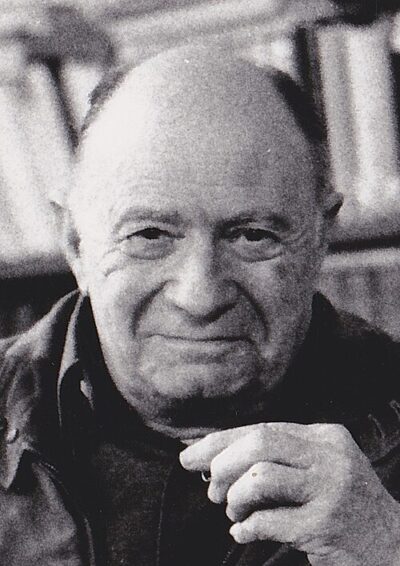
Jacques Ellul
Jacques Ellul was a French sociologist, technology critic, and Christian anarchist. Born January 6, 1912, in Bordeaux. Died May 19, 1994, in Pessac. Known for The Technological Society, The Political Illusion and Autopsy of Revolution. Educated at University of Bordeaux. Awards include Prix Européen de l'Essai Charles Veillon, Albéric-Rocheron Prize and Righteous Among the Nations.
Facts
28 facts · 2 confirmed by two sources · 8 cited · 18 from one source
Where this comes from
Papalocal keeps its own record. It started from these sources; what each one said is kept here as it was copied, so a change on their side never changes this page by itself. Tap one to read its version.
What Wikidata says · copied November 16, 2026 · revision 2567371323
- Described as
- French sociologist, technology critic, and Christian anarchist
- Born
- January 6, 1912 · 6 references
- Died
- May 19, 1994 · 6 references
- Born in
- Bordeaux · 1 reference
- Died in
- Pessac
- Name at birth
- Jacques César Émile Ellul
- Citizen of
- France
- Occupation
- theologian · 1 reference; philosopher · 1 reference; sociologist · 1 reference; university teacher · 1 reference; French resistance fighter
- Worked for
- Institut d'études politiques de Bordeaux; University of Montpellier · 1 reference; University of Bordeaux
- Education
- University of Bordeaux
- Member of
- Mouvement de la libération nationale; Combat · 1 reference
- Known for
- The Technological Society; The Political Illusion; Autopsy of Revolution; De la révolution aux révoltes; Anarchy and Christianity; Le Système technicien; Changer de révolution. L'inéluctable prolétariat
- Awards
- Prix Européen de l'Essai Charles Veillon (1975); Albéric-Rocheron Prize (1955); Righteous Among the Nations (2001) · 1 reference
- Religion
- Protestantism · 1 reference
- Wikipedias with a page
- 37
Wikidata item Q322922 (wikidata.org/wiki/Q322922), public domain (CC0). Copied November 16, 2026.
What Wikipedia says · copied November 16, 2026 · revision 1383678523
Jacques Ellul (; French: [ɛlyl]; 6 January 1912 – 19 May 1994) was a French-born philosopher, sociologist, lay theologian, resistance fighter and professor. Noted as a Christian anarchist, Ellul was a longtime professor of History and the Sociology of Institutions on the Faculty of Law and Economic Sciences at the University of Bordeaux. A prolific writer, he authored more than 60 books and more than 600 articles over his lifetime, many of which discussed propaganda, the impact of technology on society, and the interaction between religion and politics.
The dominant theme of Ellul's work proved to be the threat to human freedom and religion created by modern technology. He did not seek to eliminate modern technology or technique but sought to change our perception of them to that of a tool rather than regulator of the status quo. Among his most influential books are The Technological Society and Propaganda: The Formation of Men's Attitudes.
Considered by many to be a philosopher, Ellul was trained as a sociologist, and approached the question of technology and human action from a dialectical viewpoint. His writings are frequently concerned with the emergence of a technological tyranny over humanity. As a philosopher and theologian, he further explored the religiosity of the technological society. In 2000, the International Jacques Ellul Society was founded by a group of former Ellul students. The society, which includes scholars from a variety of disciplines, is devoted to continuing Ellul's legacy and discussing the contemporary relevance and implications of his work.
- Born, in its opening lines
- January 6, 1912
- Died, in its opening lines
- May 19, 1994
From the Wikipedia article “Jacques Ellul” (en.wikipedia.org/wiki/Jacques_Ellul), by its contributors, under CC BY-SA 4.0 (creativecommons.org/licenses/by-sa/4.0/). Copied November 16, 2026; not changed.
Confirmed Two sources agree. Cited One source, and it names where it got it. One source One source, without a reference of its own. Sources disagree The sources disagree. We show the best-supported value and keep theirs below.
