
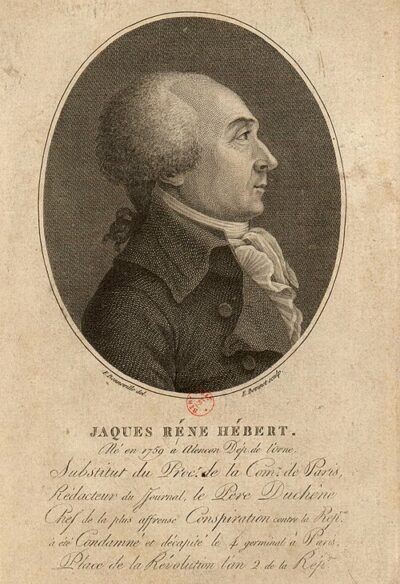
Jacques Hébert
Jacques Hébert was a French journalist and politician. Born November 15, 1757, in Alençon. Died March 24, 1794, in Paris.
Facts
12 facts · 2 confirmed by two sources · 2 cited · 8 from one source
Where this comes from
Papalocal keeps its own record. It started from these sources; what each one said is kept here as it was copied, so a change on their side never changes this page by itself. Tap one to read its version.
What Wikidata says · copied November 16, 2026 · revision 2550965273
- Described as
- French journalist and politician
- Other names
- Jacques Rene Hébert, Jacques René Hébert
- Born
- November 15, 1757 · 8 references
- Died
- March 24, 1794 · 8 references
- Born in
- Alençon
- Died in
- Paris · 1 reference
- Buried in
- Errancis Cemetery
- Cause of death
- decapitation
- Citizen of
- France
- Occupation
- journalist; politician · 1 reference; editor; writer
- Political party
- Cordeliers
- Wikipedias with a page
- 48
Wikidata item Q209901 (wikidata.org/wiki/Q209901), public domain (CC0). Copied November 16, 2026.
What Wikipedia says · copied November 16, 2026 · revision 1378381025
Jacques René Hébert (French: [ʒak ʁəne ebɛʁ]; 15 November 1757 – 24 March 1794) was a French journalist and a prominent figure of the French Revolution. The founder and editor of the radical newspaper Le Père Duchesne, he was the chief spokesman for the Parisian sans-culottes. He and his followers, known as the Hébertists, played a major role in ushering in some of the most radical measures of the revolutionary period that culminated in the Reign of Terror.
Born in Alençon into a bourgeois family, Hébert was brought to ruin by a lawsuit and fled to Paris in 1780, where he lived in destitution for nearly a decade. At the outbreak of the revolution he found success as a pamphleteer, and in 1790 he founded Le Père Duchesne, a newspaper noted for its provocative tone and ribald language that enjoyed immense popularity and widespread circulation among the Parisian working class. Hébert initially advocated in favour of a constitutional monarchy, focusing his attacks on the aristocracy and clergy. Following Louis XVI's failed flight to Varennes, he became violently critical of the monarchy as well. A member of the Cordeliers club, Hébert supported the Insurrection of 10 August 1792 and the September Massacres, and through his vitriolic rhetoric he played an active role in the fall of the Girondins in mid-1793.
Hébert advocated for a programme of radical dechristianization, which brought him into conflict with Maximilien Robespierre, whom he denounced as too moderate. The Committee of Public Safety, long concerned by the ultra-revolutionary excesses of the Hébertists, ultimately decided to take action. Following a failed call for an insurrection, Hébert was arrested in 13 March 1794 and denounced. He was guillotined ten days later.
- Born, in its opening lines
- November 15, 1757
- Died, in its opening lines
- March 24, 1794
From the Wikipedia article “Jacques Hébert” (en.wikipedia.org/wiki/Jacques_Hébert), by its contributors, under CC BY-SA 4.0 (creativecommons.org/licenses/by-sa/4.0/). Copied November 16, 2026; not changed.
Confirmed Two sources agree. Cited One source, and it names where it got it. One source One source, without a reference of its own. Sources disagree The sources disagree. We show the best-supported value and keep theirs below.
