
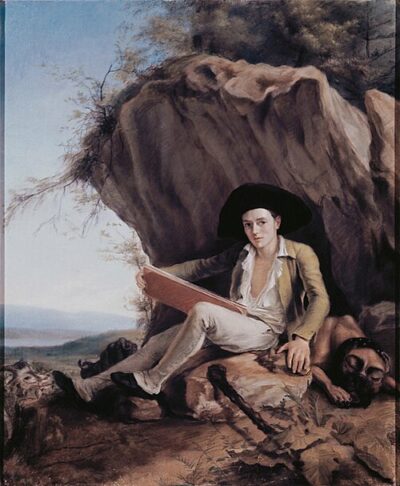
Jacques-Laurent Agasse
Jacques-Laurent Agasse was a painter. Born April 24, 1767, in Geneva. Died December 27, 1849, in London. Known for The Playground.
Facts
10 facts · 2 confirmed by two sources · 5 cited · 3 from one source
What’s different
- Born: we show April 24, 1767 (Confirmed). Wikidata also lists March 24, 1767
Where this comes from
Papalocal keeps its own record. It started from these sources; what each one said is kept here as it was copied, so a change on their side never changes this page by itself. Tap one to read its version.
What Wikidata says · copied November 17, 2026 · revision 2560181658
- Described as
- painter (1767-1849)
- Other names
- Jacques Laurent Agace, J. L. Agasse, Jacques Laurent Agasser, Jacques Laurent Agasse, J.-L. Agasse, Agass, Agace, Agasser, James Laurent Agasse, Agasse, j. l. agasse, jacques agasse
- Born
- April 24, 1767 · 1 reference; March 24, 1767 · 2 references
- Died
- December 27, 1849 · 8 references
- Born in
- Geneva · 1 reference
- Died in
- London · 1 reference
- Citizen of
- Republic of Geneva · 1 reference
- Occupation
- painter · 1 reference; artist · 1 reference
- Genre
- landscape painting
- Known for
- The Playground
- Religion
- reformed · 1 reference
- Wikipedias with a page
- 25
Wikidata item Q506256 (wikidata.org/wiki/Q506256), public domain (CC0). Copied November 17, 2026.
What Wikipedia says · copied November 17, 2026 · revision 1365883927
Jacques-Laurent Agasse (April 24, 1767 – December 27, 1849) was an animal and landscape painter from Switzerland.
Born at Geneva, Agasse studied in the public art school of that city. Before he turned twenty he went to Paris to study in veterinary school to make himself fully acquainted with the anatomy of horses and other animals. He seems to have subsequently returned to Switzerland. The Tübinger Morgenblatt (1808, p. 876) says that "Agasse, the celebrated animal painter, now in England, owed his fortune to an accident. About eight years ago, he being then in Switzerland, a rich Englishman (George Pitt, later Lord Rivers) asked him to paint his favourite dog (greyhound) which had died. The Englishman was so pleased with his work that he took the painter to England with him."
Nagler says that he was one of the most celebrated animal painters at the end of the 18th and the beginning of the 19th century. In Johann Georg Meusel's Neue Miscellaneen (viii. 1052 et seq.), he compares Agasse and Wouwermans, wholly in favour of the former. In that partial article much is said of his extreme devotion to art, of his marvelous knowledge of anatomy, of his special fondness for the English racehorses, and his excellence in depicting them. He appears first in the academy catalogues in 1801 as the exhibitor of the 'Portrait of a Horse', and continued to exhibit more or less until 1845 (contradicting Nagler's statement that he died "about" 1806).
In the catalogues his name is given as J.L. Agasse or Agassé. The number of times Agassé changed his address confirms Redgrave's assertion that "he lived poor and died poor". The writer of the panegyric already quoted says, however, that he did not work for money, but that he was urged forward by the resistless force of natural genius.
- Born, in its opening lines
- April 24, 1767
- Died, in its opening lines
- December 27, 1849
From the Wikipedia article “Jacques-Laurent Agasse” (en.wikipedia.org/wiki/Jacques-Laurent_Agasse), by its contributors, under CC BY-SA 4.0 (creativecommons.org/licenses/by-sa/4.0/). Copied November 17, 2026; not changed.
Confirmed Two sources agree. Cited One source, and it names where it got it. One source One source, without a reference of its own. Sources disagree The sources disagree. We show the best-supported value and keep theirs below.
