
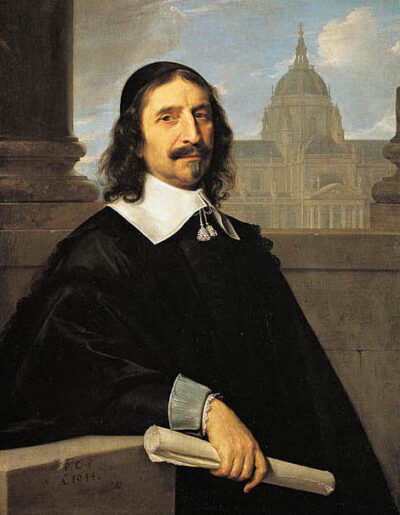
Jacques Lemercier was a French architect. Born 1585, in Pontoise. Died January 13, 1654, in Paris. Known for Chapelle Sainte-Ursule de la Sorbonne and Pavillon de l'Horloge.
Facts
15 facts · 0 confirmed by two sources · 8 cited · 7 from one source
Where this comes from
Papalocal keeps its own record. It started from these sources; what each one said is kept here as it was copied, so a change on their side never changes this page by itself. Tap one to read its version.
What Wikidata says · copied November 18, 2026 · revision 2557944425
- Described as
- French architect (1585–1654)
- Other names
- Jacques Le Mercier
- Born
- 1585 · 9 references
- Died
- January 13, 1654 · 1 reference
- Born in
- Pontoise · 1 reference
- Died in
- Paris · 1 reference
- Citizen of
- France · 1 reference
- Occupation
- architect · 3 references; graphic artist; urban planner; sculptor · 1 reference; master builder · 1 reference; engineer · 1 reference
- Known for
- Chapelle Sainte-Ursule de la Sorbonne; Pavillon de l'Horloge
- Field
- architecture · 1 reference
- Father
- Nicolas Le Mercier
- Wikipedias with a page
- 22
Wikidata item Q708858 (wikidata.org/wiki/Q708858), public domain (CC0). Copied November 18, 2026.
What Wikipedia says · copied November 18, 2026 · revision 1373293598
Jacques Lemercier (French pronunciation: [ʒak ləmɛʁsje]; c. 1585 in Pontoise – 13 January 1654 in Paris) was a French architect and engineer, one of the influential trio that included Louis Le Vau and François Mansart who formed the classicizing French Baroque manner, drawing from French traditions of the previous century and current Roman practice the fresh, essentially French synthesis associated with Cardinal Richelieu and King Louis XIII.
From the Wikipedia article “Jacques Lemercier” (en.wikipedia.org/wiki/Jacques_Lemercier), by its contributors, under CC BY-SA 4.0 (creativecommons.org/licenses/by-sa/4.0/). Copied November 18, 2026; not changed.
Confirmed Two sources agree. Cited One source, and it names where it got it. One source One source, without a reference of its own. Sources disagree The sources disagree. We show the best-supported value and keep theirs below.
