
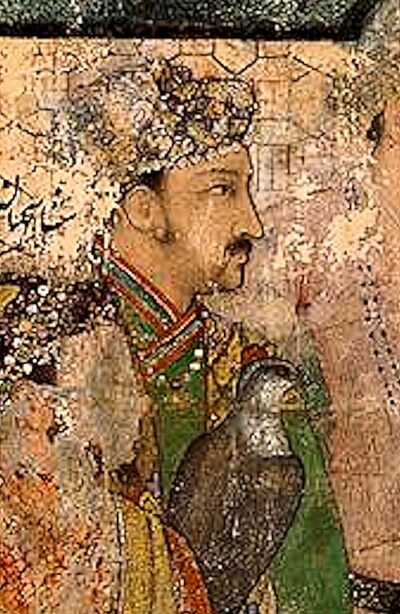
Jahangir I
Jahangir I was the fourth Mughal Emperor from 1605 to 1627. Born August 30, 1569, in Fatehpur Sikri. Died October 28, 1627, in Rajauri. Positions held include Mughal emperor (1605–1627).
Facts
23 facts · 1 confirmed by two sources · 3 cited · 18 from one source · 1 where the sources disagree
What’s different
- Born: we show August 30, 1569 (Sources disagree). Wikipedia says August 31, 1569
Where this comes from
Papalocal keeps its own record. It started from these sources; what each one said is kept here as it was copied, so a change on their side never changes this page by itself. Tap one to read its version.
What Wikidata says · copied November 16, 2026 · revision 2568222703
- Described as
- the fourth Mughal Emperor from 1605 to 1627
- Other names
- Nur-ud-din Mohammad Salim, Nur al-Dīn MuỌhammad Jahāngīr Gūrkānī, empereur moghol de l'Inde Jahangīr, Emperor of Hindustan Jahangir, Großmogul Jahangir Mogulreich, Jehangir
- Born
- August 30, 1569 · 1 reference
- Died
- October 28, 1627 · 3 references
- Born in
- Fatehpur Sikri · 1 reference
- Died in
- Rajauri
- Buried in
- Tomb of Jahangir
- Occupation
- monarch
- Positions held
- Mughal emperor (1605–1627)
- Spouse
- Nur-un-Nissa Begum; Khas Mahal; Saliha Banu Begum; Malika Jahan; Shah Begum · 1 reference; Jagat Gosain
- Children
- Shah Jahan · 1 reference; Khusrau Mirza; Parviz; Sheharyar · 1 reference; Bahar Banu Begum
- Father
- Akbar
- Mother
- Mariam-uz-Zamani
- Siblings
- Prince Daniyal; Prince Murad
- Religion
- Islam
- Wikipedias with a page
- 82
Wikidata item Q83653 (wikidata.org/wiki/Q83653), public domain (CC0). Copied November 16, 2026.
What Wikipedia says · copied November 16, 2026 · revision 1385862925
Nur ud-din Muhammad Salim (Persian: نورالدین محمد سلیم [ˈnuːrʊˌdɪn/ [mʊ.ɦɑmˈmad̪̚] /sə.liːm]; 31 August 1569 – 28 October 1627), known by his royal name Jahangir (Persian: جهانگیر, Persian pronunciation: [d͡ʒa.hɑːn.ˈɡiːɾ]), was the fourth Mughal emperor of the Mughal Empire, reigning from 1605 until his death in 1627.
The third and only surviving son of Emperor Akbar I (r. 1556–1605) and his consort Maryam uz-Zamani. Jahangir received a comprehensive education, which included the languages Chagatai, Persian, and Hindustani, as well as diverse subjects such as military tactics and social sciences. In 1594, at the age of 26, Jahangir successfully led an army to crush a revolt by the Bundela in Orchha, and after the surrender of their leader Vir Singh Deo, transformed Orchha into a vassal state. As such, the Jahangir Mahal was later constructed in Orchha by Deo in honor of Jahangir. Following Akbar's death, Jahangir succeeded him on 3 November 1605.
Jahangir's reign was marked by a combination of artistic achievement and political intrigue, set against the backdrop of the Mughal Empire's considerable expansion and consolidation. Jahangir's rule is distinguished by his commitment to justice and his interest in the arts, particularly painting and architecture, which flourished during his reign. Jahangir's reign was characterized by a complex relationship with his nobility and family, notably reflected in his marriage to Mehar-un-Nisa (later known as Empress Nur Jahan), who wielded significant political influence behind the throne. This period saw the empire's further entrenchment into the Indian subcontinent, including efforts to subdue the Rajput Kingdoms and extend Mughal authority into the Deccan. Jahangir's foreign policy included relations with the Safavids of Persia and the Ottoman Empire, as well as with the English East India Company.
Despite his achievements, Jahangir's reign had challenges, including revolts led by his sons, which threatened the stability of his rule. His poor health, caused by a lifetime of opium and alcohol use, led to his death in 1627, precipitating a brief succession crisis before the throne passed to his son, Shah Jahan. Jahangir's legacy lives on through his contributions to Mughal art and architecture, his memoirs, and the policies he implemented, which continued to influence the empire after his demise.
- Born, in its opening lines
- August 31, 1569
- Died, in its opening lines
- October 28, 1627
From the Wikipedia article “Jahangir” (en.wikipedia.org/wiki/Jahangir), by its contributors, under CC BY-SA 4.0 (creativecommons.org/licenses/by-sa/4.0/). Copied November 16, 2026; not changed.
Confirmed Two sources agree. Cited One source, and it names where it got it. One source One source, without a reference of its own. Sources disagree The sources disagree. We show the best-supported value and keep theirs below.
