
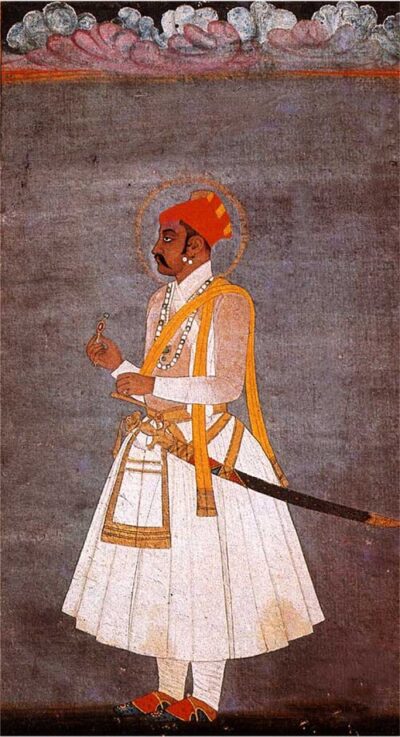
Jai Singh II was a Maharaja of Jaipur. Born November 3, 1688, in Amber. Died September 21, 1743, in Jaipur.
Facts
10 facts · 2 confirmed by two sources · 0 cited · 8 from one source
Where this comes from
Papalocal keeps its own record. It started from these sources; what each one said is kept here as it was copied, so a change on their side never changes this page by itself. Tap one to read its version.
What Wikidata says · copied November 18, 2026 · revision 2568780981
- Described as
- Maharaja of Jaipur
- Other names
- Maharaja of Jaipur Jai Singh II, Sawai Jai Singh II, Sawai Jai Singh, Majaraja Jai Singh II, Raja Jai Singh II, Maharaja Sawai Jai Singh II, maharaja of Jaipur Jai Singh II
- Born
- November 3, 1688
- Died
- September 21, 1743 · 1 reference
- Born in
- Amber
- Died in
- Jaipur
- Citizen of
- Mughal Empire · 1 reference
- Occupation
- king
- Children
- Madho Singh I · 1 reference; Ishvari Singh
- Father
- Bishan Singh
- Religion
- Hinduism
- Wikipedias with a page
- 21
Wikidata item Q2392864 (wikidata.org/wiki/Q2392864), public domain (CC0). Copied November 18, 2026.
What Wikipedia says · copied November 18, 2026 · revision 1383383125
Sawai Jai Singh II (3 November 1688 – 21 September 1743), was the 30th Kachhwaha ruler of the Kingdom of Amber, who later founded the fortified city of Jaipur and made it his capital. He became the ruler of Amber at the age of 11, after the untimely death of his father Mirza Raja Bishan Singh on 31 December 1699.
Initially, Raja Jai Singh served as a vassal of the Mughal Empire. He was given the title of "Sawai" by Mughal Emperor Aurangzeb before the siege of Vishalgad Fort in Deccan. "Sawai" means one and a quarter times superior to his contemporaries. He received the title of "Maharaja Sawai, Raj Rajeshwar, Shri Rajadhiraj " in the year 1723 which happened to be the reign of later Mughals under emperor Muhammad Shah; this was in addition to the title of "Saramad-i-Raja-i-Hindustan", conferred on him on 21 April 1721.
Sawai Mirza Raja Jai Singh asserted his sovereignty by performing the Ashvamedha sacrifice, an ancient rite that is conducted by high rulers. He moved his kingdom's capital from the town of Amber to the newly established walled city of Jaipur in 1727 and performed two Ashwamedha sacrifices, one in 1734, and again in 1741.
Sawai Jai Singh II other than administration and state craftship had a profound interest in the fields of Mathematics, Architecture, Astronomy, Astrology and Literature. He commissioned the Jantar Mantar observatories at multiple places in India, including his capital Jaipur. He had Euclid's "Elements of Geometry" translated into Sanskrit.
- Born, in its opening lines
- November 3, 1688
- Died, in its opening lines
- September 21, 1743
From the Wikipedia article “Sawai Jai Singh” (en.wikipedia.org/wiki/Sawai_Jai_Singh), by its contributors, under CC BY-SA 4.0 (creativecommons.org/licenses/by-sa/4.0/). Copied November 18, 2026; not changed.
Confirmed Two sources agree. Cited One source, and it names where it got it. One source One source, without a reference of its own. Sources disagree The sources disagree. We show the best-supported value and keep theirs below.
