
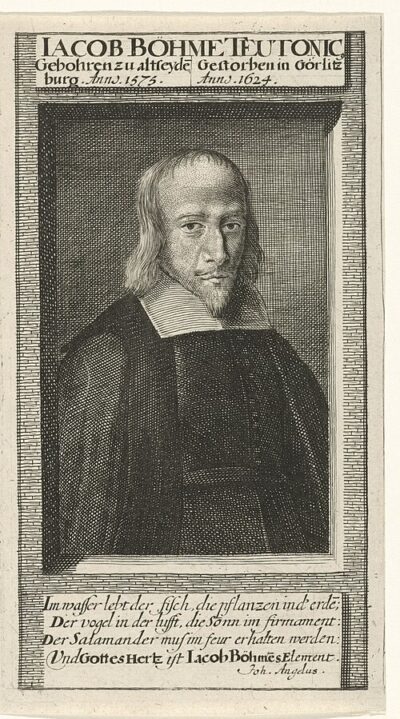
Jakob Böhme
Jakob Böhme was a German Christian mystic and theologian. Born April 24, 1575, in Stary Zawidów. Died November 17, 1624, in Görlitz. Known for The Aurora.
Facts
11 facts · 2 confirmed by two sources · 4 cited · 5 from one source
Where this comes from
Papalocal keeps its own record. It started from these sources; what each one said is kept here as it was copied, so a change on their side never changes this page by itself. Tap one to read its version.
What Wikidata says · copied November 16, 2026 · revision 2569203367
- Described as
- German Christian mystic and theologian (1575-1624)
- Other names
- Jacob Boehme, Jakob Bohme
- Born
- April 24, 1575 · 3 references
- Died
- November 17, 1624 · 6 references
- Born in
- Stary Zawidów · 1 reference
- Died in
- Görlitz · 3 references
- Citizen of
- Germany
- Occupation
- philosopher · 1 reference; theologian; writer · 1 reference
- Known for
- The Aurora
- Religion
- Lutheranism
- Website
- http://jacob-boehme.org/
- Wikipedias with a page
- 59
Wikidata item Q77017 (wikidata.org/wiki/Q77017), public domain (CC0). Copied November 16, 2026.
What Wikipedia says · copied November 16, 2026 · revision 1361902678
Jakob Böhme (; German: [ˈbøːmə]; 24 April 1575 – 17 November 1624) was a German philosopher, Christian mystic, and Lutheran Protestant theologian. He was considered an original thinker by many of his contemporaries within the Lutheran tradition, and his first book, commonly known as Aurora, caused a great scandal. In contemporary English, his name may be spelled Jacob Boehme (retaining the older German spelling); in seventeenth-century England it was also spelled Behmen, approximating the contemporary English pronunciation of the German Böhme.
Böhme had a profound influence on later philosophical movements such as German idealism and German Romanticism. Hegel described Böhme as "the first German philosopher".
- Born, in its opening lines
- April 24, 1575
- Died, in its opening lines
- November 17, 1624
From the Wikipedia article “Jakob Böhme” (en.wikipedia.org/wiki/Jakob_Böhme), by its contributors, under CC BY-SA 4.0 (creativecommons.org/licenses/by-sa/4.0/). Copied November 16, 2026; not changed.
Confirmed Two sources agree. Cited One source, and it names where it got it. One source One source, without a reference of its own. Sources disagree The sources disagree. We show the best-supported value and keep theirs below.
