
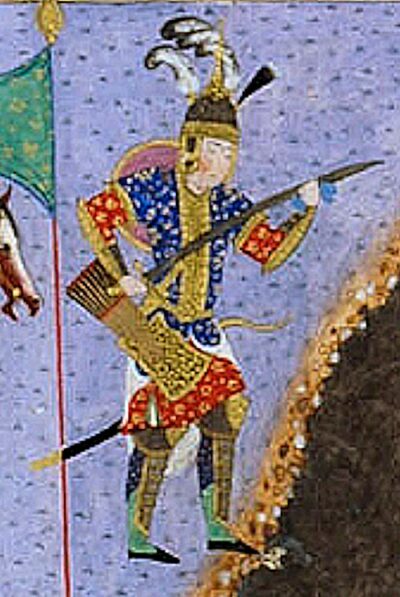
Jalal ad-Din Mingburnu
Jalal ad-Din Mingburnu was a Ruler of the Khwarazmian Empire. Born 1199, in Khwarazm. Died August 15, 1231, in Asia Minor. Positions held include Khwarazmshah (1220–1231).
Facts
9 facts · 0 confirmed by two sources · 0 cited · 9 from one source
Where this comes from
Papalocal keeps its own record. It started from these sources; what each one said is kept here as it was copied, so a change on their side never changes this page by itself. Tap one to read its version.
What Wikidata says · copied November 16, 2026 · revision 2563638687
- Described as
- Ruler of the Khwarazmian Empire
- Other names
- Jalal al-Din Mangburni
- Born
- 1199
- Died
- August 15, 1231
- Born in
- Khwarazm
- Died in
- Asia Minor
- Occupation
- sovereign
- Positions held
- Khwarazmshah (1220–1231)
- Spouse
- Tamta
- Father
- Muhammad II of Khwarazm
- Mother
- Ay-Chichek
- Wikipedias with a page
- 39
Wikidata item Q559416 (wikidata.org/wiki/Q559416), public domain (CC0). Copied November 16, 2026.
What Wikipedia says · copied November 16, 2026 · revision 1383130294
Jalal al-Din Mangburni (Persian: جلال الدین مِنکُبِرنی), also known as Jalal al-Din Khwarazmshah (جلال الدین خوارزمشاه), was the last Khwarazmshah of the Anushtegin dynasty. The eldest son and successor of Ala ad-Din Muhammad II of the Khwarazmian Empire, Jalal al-Din was brought up at Gurganj, the wealthy capital of the Khwarazmid homeland. An able general, he served as second-in-command to his father in at least one battle; however, since he was the son of a concubine, he was challenged as successor by a younger brother, whose cause was supported by the powerful Queen Mother, Terken Khatun. Nevertheless, after the Mongol conquest of the Khwarazmian Empire led to his father's flight and death on an island in the Caspian Sea, Jalal-al Din gained the loyalty of the majority of Khwarazmian loyalists.
The new Shah Jalal al-Din moved to Gurganj, but departed eastwards after Terken Khatun moved against him; evading Mongol patrols, he gathered a substantial army at Ghazni. He managed to inflict an excellent defeat on Shigi Qutuqu at the Battle of Parwan, but soon lost a good portion of his army in a dispute over spoils. He was defeated by a vengeful Genghis Khan at the Battle of the Indus, and fled across the river. Now essentially a warlord, Jalal al-Din managed to establish a succession of short-lived states: first in the Punjab from 1222 to 1224, and then in northwest Iran and Georgia after 1225. Jalal al-Din did not have the political ability needed to underpin his martial exploits, and he was forced to combat several large revolts and increasing pressure from Mongol forces. Eventually, he was killed in 15 August 1231. The army he had gathered would continue to terrorize the Levant as the mercenary Khwarazmiyya until its final defeat in 1246.
From the Wikipedia article “Jalal al-Din Mangburni” (en.wikipedia.org/wiki/Jalal_al-Din_Mangburni), by its contributors, under CC BY-SA 4.0 (creativecommons.org/licenses/by-sa/4.0/). Copied November 16, 2026; not changed.
Confirmed Two sources agree. Cited One source, and it names where it got it. One source One source, without a reference of its own. Sources disagree The sources disagree. We show the best-supported value and keep theirs below.
