
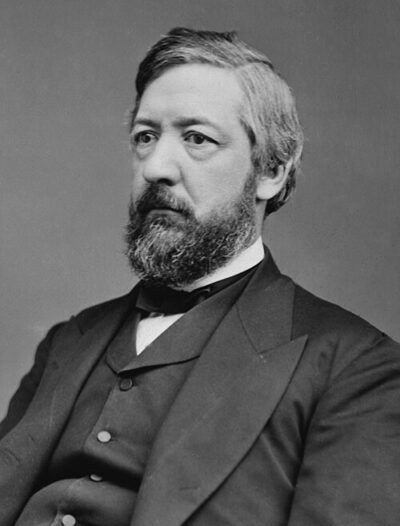
James G. Blaine
James G. Blaine was an American politician. Born January 31, 1830, in West Brownsville. Died January 27, 1893, in Washington, D.C.. Positions held include United States representative, member of the Maine House of Representatives and United States Secretary of State (2 times) (1881–1892). Educated at Washington & Jefferson College.
Facts
30 facts · 2 confirmed by two sources · 8 cited · 20 from one source
Where this comes from
Papalocal keeps its own record. It started from these sources; what each one said is kept here as it was copied, so a change on their side never changes this page by itself. Tap one to read its version.
What Wikidata says · copied November 14, 2026 · revision 2562945177
- Described as
- American politician (1830–1893)
- Other names
- James Gillespie Blaine, James Blaine
- Born
- January 31, 1830 · 5 references
- Died
- January 27, 1893 · 5 references
- Born in
- West Brownsville · 2 references
- Died in
- Washington, D.C. · 2 references
- Buried in
- Blaine Memorial Park
- Cause of death
- myocardial infarction
- Citizen of
- United States
- Occupation
- politician · 2 references; lawyer; diplomat; journalist; editor; writer · 1 reference
- Positions held
- United States representative; member of the Maine House of Representatives; United States Secretary of State (2 times) (1881–1892); Speaker of the United States House of Representatives (1869–1875); United States senator (1876–1881) · 1 reference
- Political party
- Republican Party
- Education
- Washington & Jefferson College
- Spouse
- Harriet Stanwood Blaine (1850–) · 1 reference
- Children
- Walker Blaine; Harriet S. Blaine Beale; Emmons Blaine; James G. Blaine Jr.; Margaret Blaine Damrosch
- Father
- Ephraim Lyon Blaine · 1 reference
- Mother
- Maria Louise Gillespie
- Religion
- congregationalist polity
- Lived in
- The Blaine House · 1 reference
- Wikipedias with a page
- 39
Wikidata item Q448778 (wikidata.org/wiki/Q448778), public domain (CC0). Copied November 14, 2026.
What Wikipedia says · copied November 14, 2026 · revision 1384185981
James Gillespie Blaine (January 31, 1830 – January 27, 1893) was an American statesman and Republican politician who represented Maine in the United States House of Representatives from 1863 to 1876, served as Speaker of the House from 1869 to 1875, and was a United States senator from 1876 to 1881. He served twice as Secretary of State, under presidents James A. Garfield and Chester A. Arthur in 1881, and under Benjamin Harrison from 1889 to 1892. He sought the Republican presidential nomination in 1876 and 1880, and received the nomination in 1884, narrowly losing the general election to Democratic nominee Grover Cleveland. Blaine was a prominent figure in the moderate faction of the Republican Party, known as the "Half-Breeds".
Born in West Brownsville, Pennsylvania, Blaine moved to Maine after college, where he worked as a newspaper editor in Augusta before entering politics. Contemporary sources described him as an effective public speaker during an era when oratory was highly valued in American politics. He supported Abraham Lincoln and the Union cause during the American Civil War, and during Reconstruction he advocated for voting rights for former slaves while opposing some of the more punitive measures favored by Radical Republicans. His economic positions evolved from supporting high tariffs to favoring reduced tariffs and expanded international trade. Throughout his career, Blaine faced allegations of improper financial dealings with railroad companies, particularly concerning the Mulligan letters. While these allegations were never substantiated with conclusive evidence, they became a significant issue in his 1884 presidential campaign.
As Secretary of State, Blaine advocated for expanded American involvement in international affairs, marking a shift from the more limited foreign policy approaches of previous decades. He promoted increased trade relationships, particularly with Latin American nations, and supported policies that came to be known as tariff reciprocity. His diplomatic approach emphasized American commercial interests and included support for territorial expansion in the Caribbean and Pacific regions. His foreign policy initiatives contributed to the development of more assertive American international engagement that would be further expanded during and after the Spanish–American War.
- Born, in its opening lines
- January 31, 1830
- Died, in its opening lines
- January 27, 1893
From the Wikipedia article “James G. Blaine” (en.wikipedia.org/wiki/James_G._Blaine), by its contributors, under CC BY-SA 4.0 (creativecommons.org/licenses/by-sa/4.0/). Copied November 14, 2026; not changed.
Confirmed Two sources agree. Cited One source, and it names where it got it. One source One source, without a reference of its own. Sources disagree The sources disagree. We show the best-supported value and keep theirs below.
