
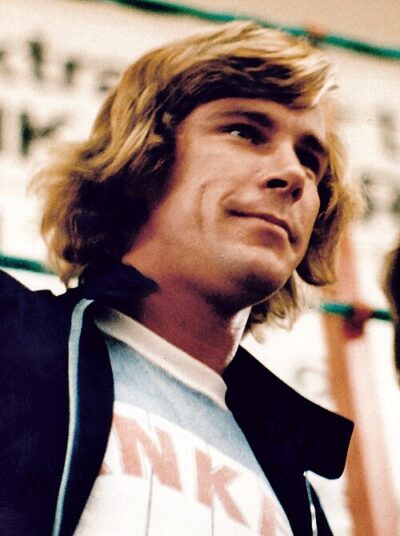
James Hunt
James Hunt was a British racing driver. Born August 29, 1947, in Belmont. Died June 15, 1993, in Wimbledon. Teams include Hesketh Racing, McLaren and Wolf Racing Cars. Educated at Wellington College.
Facts
23 facts · 2 confirmed by two sources · 8 cited · 13 from one source
Where this comes from
Papalocal keeps its own record. It started from these sources; what each one said is kept here as it was copied, so a change on their side never changes this page by itself. Tap one to read its version.
What Wikidata says · copied November 16, 2026 · revision 2549528186
- Described as
- British racing driver (1947–1993)
- Other names
- James Simon Wallis Hunt
- Born
- August 29, 1947 · 3 references
- Died
- June 15, 1993 · 4 references
- Born in
- Belmont
- Died in
- Wimbledon
- Buried in
- Putney Vale Cemetery
- Cause of death
- myocardial infarction
- Name at birth
- James Simon Wallis Hunt
- Citizen of
- United Kingdom
- Occupation
- Formula One driver (1973–1979); racing automobile driver · 1 reference; broadcaster · 1 reference
- Education
- Wellington College
- Teams
- Hesketh Racing; McLaren; Wolf Racing Cars
- Sport
- auto racing
- Field
- auto race · 1 reference; Formula One · 1 reference; Formula One race · 1 reference
- Spouse
- Suzy Miller (1974–1976) · 2 references
- Father
- Wallis Hunt · 1 reference
- Mother
- Sue · 1 reference
- Siblings
- David Hunt
- Wikipedias with a page
- 56
Wikidata item Q140393 (wikidata.org/wiki/Q140393), public domain (CC0). Copied November 16, 2026.
What Wikipedia says · copied November 16, 2026 · revision 1385777812
James Simon Wallis Hunt (29 August 1947 – 15 June 1993) was a British racing driver and broadcaster who competed in Formula One from 1973 to 1979. Nicknamed "the Shunt", Hunt won the Formula One World Drivers' Championship in 1976 with McLaren and won 10 Grands Prix across seven seasons.
Born and raised in Surrey, Hunt began his racing career in touring cars before progressing to Formula Three in 1969, where he attracted the attention of Lord Hesketh, founder of Hesketh Racing. Hunt earned notoriety throughout his early career for his reckless and action-packed exploits on track, along with his playboy lifestyle off it. He signed for Hesketh in 1973—driving a March 731 chassis designed by Harvey Postlethwaite—making his Formula One debut at the Monaco Grand Prix; he took podiums in his rookie season at the Dutch and United States Grands Prix. Hesketh entered their own 308 chassis in 1974, in which Hunt achieved several podiums and won the non-championship BRDC International Trophy.
Retaining his seat the following season, Hunt took his maiden victory with Hesketh at the Dutch Grand Prix, widely regarded as one of the greatest underdog victories in Formula One history. The team was left without sponsorship at the end of the season, leading Hunt to join McLaren for his 1976 campaign. Amidst a fierce title battle with Niki Lauda, Hunt won the World Drivers' Championship by a single point in his debut season with McLaren. He won several further races in 1977, dropping to fifth in the standings amidst reliability issues. After a winless 1978 season for McLaren, Hunt moved to Wolf in 1979 and retired after the Monaco Grand Prix, having achieved 10 race wins, 14 pole positions, eight fastest laps, and 23 podiums in Formula One.
Upon retiring from motor racing, Hunt established a career as a commentator and pundit for the BBC, as well as a columnist for The Independent. Through Marlboro, he also mentored two-time World Drivers' Champion Mika Häkkinen. He died from a heart attack at his home in Wimbledon, aged 45.
- Born, in its opening lines
- August 29, 1947
- Died, in its opening lines
- June 15, 1993
From the Wikipedia article “James Hunt” (en.wikipedia.org/wiki/James_Hunt), by its contributors, under CC BY-SA 4.0 (creativecommons.org/licenses/by-sa/4.0/). Copied November 16, 2026; not changed.
Confirmed Two sources agree. Cited One source, and it names where it got it. One source One source, without a reference of its own. Sources disagree The sources disagree. We show the best-supported value and keep theirs below.
