
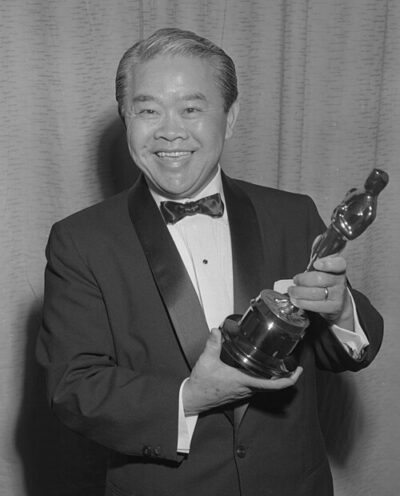
James Wong Howe
James Wong Howe was a Chinese-American film director and cinematographer. Born August 28, 1899, in Taishan. Died July 12, 1976, in Hollywood. Awards include Academy Award for Best Cinematography, Black-and-White (2 times).
Facts
16 facts · 2 confirmed by two sources · 6 cited · 8 from one source
Where this comes from
Papalocal keeps its own record. It started from these sources; what each one said is kept here as it was copied, so a change on their side never changes this page by itself. Tap one to read its version.
What Wikidata says · copied November 15, 2026 · revision 2570013431
- Described as
- Chinese-American film director and cinematographer (1899–1976)
- Other names
- Huang Zongzhan, Wong Tung Jim
- Born
- August 28, 1899 · 6 references
- Died
- July 12, 1976 · 6 references
- Born in
- Taishan
- Died in
- Hollywood · 1 reference
- Buried in
- Westwood Village Memorial Park Cemetery
- Name at birth
- 黃宗霑
- Citizen of
- United States; Qing dynasty
- Occupation
- film director; cinematographer · 1 reference; camera operator; director · 1 reference
- Awards
- Academy Award for Best Cinematography, Black-and-White (2 times) (1956, 1964) · 1 reference
- Field
- film · 1 reference; television · 1 reference
- Spouse
- Sanora Babb (1937–1976) · 1 reference
- Wikipedias with a page
- 27
Wikidata item Q266521 (wikidata.org/wiki/Q266521), public domain (CC0). Copied November 15, 2026.
What Wikipedia says · copied November 15, 2026 · revision 1378811314
James Wong Howe, ASC (born Wong Tung Jim, Chinese: 黃宗霑; August 28, 1899 – July 12, 1976) was a Chinese-born American cinematographer and film director, who worked on over 130 films during the Golden Age of Hollywood and well into the 1970s. During the 1930s and 1940s, he was one of the most sought after cinematographers in Hollywood due to his innovative filming techniques. Howe was known as a master of the use of shadow and one of the first to use deep-focus cinematography.
Born in Guangdong, Howe immigrated to the United States at age five and grew up in Washington. He was a professional boxer during his teenage years, and later began his career in the film industry as an assistant to Cecil B. DeMille. Howe pioneered the use of wide-angle lenses and low-key lighting, as well as the use of the crab dolly.
Despite the success of his professional life, Howe faced significant racial discrimination in his private life. He became an American citizen only after the repeal of the Chinese Exclusion Act in 1943, and due to anti-miscegenation laws, his marriage to Sanora Babb, a white woman, was not legally recognized in the state of California until 1948.
Howe earned 10 nominations for the Academy Award for Best Cinematography, winning twice, once for The Rose Tattoo (1955), and once more for Hud (1963). He also received Oscar nominations for Algiers (1938), Abe Lincoln in Illinois (1940), Kings Row (1942), The North Star (1943), Air Force (1943), The Old Man and the Sea (1958), Seconds (1966), and Funny Lady (1975). He was selected as one of the 10 most influential cinematographers in a survey of the members of the International Cinematographers Guild.
- Born, in its opening lines
- August 28, 1899
- Died, in its opening lines
- July 12, 1976
From the Wikipedia article “James Wong Howe” (en.wikipedia.org/wiki/James_Wong_Howe), by its contributors, under CC BY-SA 4.0 (creativecommons.org/licenses/by-sa/4.0/). Copied November 15, 2026; not changed.
Confirmed Two sources agree. Cited One source, and it names where it got it. One source One source, without a reference of its own. Sources disagree The sources disagree. We show the best-supported value and keep theirs below.
