
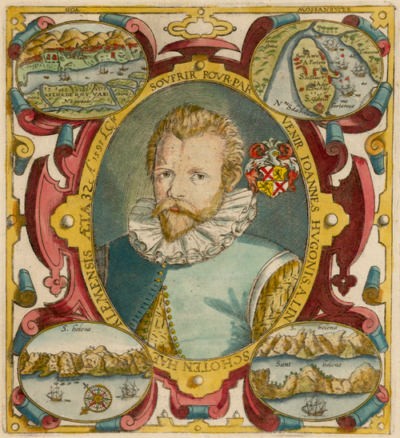
Jan Huyghen van Linschoten
Jan Huyghen van Linschoten was a Dutch Protestant merchant, traveller and historian. Born 1563, in Haarlem. Died February 8, 1611, in Enkhuizen.
Facts
10 facts · 2 confirmed by two sources · 4 cited · 4 from one source
Where this comes from
Papalocal keeps its own record. It started from these sources; what each one said is kept here as it was copied, so a change on their side never changes this page by itself. Tap one to read its version.
What Wikidata says · copied November 18, 2026 · revision 2568065418
- Described as
- Dutch Protestant merchant, traveller and historian (1563–1611)
- Other names
- Jan Huygen van Linschoten, Iean Hugues de Linschot, Jan Huygen Van Linschoten, Ioannes Hugonius, Jean Hugues de Linscot, Joannes Hugonius, Iohannis Hugonis Linscotani
- Born
- 1563 · 21 references
- Died
- February 8, 1611 · 5 references
- Born in
- Haarlem · 1 reference
- Died in
- Enkhuizen · 1 reference
- Citizen of
- Dutch Republic
- Occupation
- writer; historian · 1 reference; merchant; seafarer; cartographer · 3 references
- Wikipedias with a page
- 22
Wikidata item Q941383 (wikidata.org/wiki/Q941383), public domain (CC0). Copied November 18, 2026.
What Wikipedia says · copied November 18, 2026 · revision 1365943032
Jan Huygen van Linschoten (1563 – 8 February 1611) was a Dutch merchant, traveller and writer.
He travelled extensively along the East Indies regions under Portuguese influence and served as the archbishop's secretary in Goa between 1583 and 1588. He is credited with publishing in Europe important classified information about Asian trade and navigation that was hidden by the Portuguese. In 1596, he published a book, Itinerario (later translated as Discours of Voyages into Ye East & West Indies), which graphically displayed for the first time in Europe detailed maps of voyages to the East Indies, particularly India.
During his stay in Goa, he meticulously copied the secret charts page by page. Even more crucially, he provided nautical data like currents, deeps, islands and sandbanks that were vital for safe navigation, along with coastal depictions to guide the way. The publication of the navigational routes enabled the passage to the East Indies to be opened to trading by the Dutch, French and the English. As a consequence, the Dutch East India Company and the British East India Company would break the 16th-century monopoly enjoyed by the Portuguese on trade with the East Indies.
- Born, in its opening lines
- 1563
- Died, in its opening lines
- February 8, 1611
From the Wikipedia article “Jan Huyghen van Linschoten” (en.wikipedia.org/wiki/Jan_Huyghen_van_Linschoten), by its contributors, under CC BY-SA 4.0 (creativecommons.org/licenses/by-sa/4.0/). Copied November 18, 2026; not changed.
Confirmed Two sources agree. Cited One source, and it names where it got it. One source One source, without a reference of its own. Sources disagree The sources disagree. We show the best-supported value and keep theirs below.
