
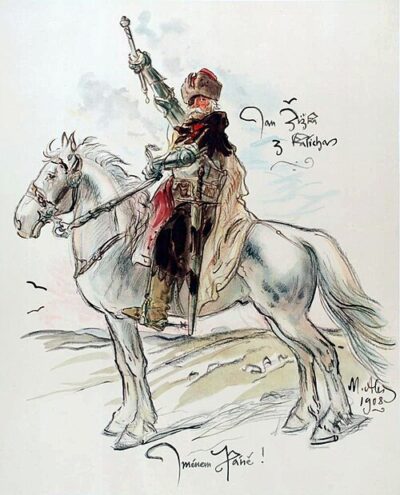
Jan Žižka
Jan Žižka was a Czech Hussite military leader (circa 1360 - 1424). Born 1360, in Trocnov. Died October 11, 1424, in Přibyslav.
Facts
13 facts · 2 confirmed by two sources · 6 cited · 4 from one source · 1 where the sources disagree
What’s different
- Died in: we show Přibyslav (Sources disagree). Wikidata also lists Žižkovo Pole
Where this comes from
Papalocal keeps its own record. It started from these sources; what each one said is kept here as it was copied, so a change on their side never changes this page by itself. Tap one to read its version.
What Wikidata says · copied November 16, 2026 · revision 2568066288
- Described as
- Czech Hussite military leader (circa 1360 - 1424)
- Other names
- John the One-Eyed, Jan Žižka z Trocnova a Kalicha, Žižka of the Chalice, John of the Chalice, John ŽIžka of the Chalice, John Ziska, John of Trotznov, Johann Ziska
- Born
- 1360 · 3 references
- Died
- October 11, 1424 · 7 references
- Born in
- Trocnov · 3 references
- Died in
- Žižkovo Pole; Přibyslav · 3 references
- Cause of death
- plague
- Citizen of
- Kingdom of Bohemia
- Occupation
- military leader · 3 references; politician · 1 reference; soldier · 1 reference
- Field
- military affairs · 2 references; Hussites · 2 references
- Siblings
- Jaroslav z Trocnova
- Military rank
- commander-in-chief
- Wikipedias with a page
- 52
Wikidata item Q215968 (wikidata.org/wiki/Q215968), public domain (CC0). Copied November 16, 2026.
What Wikipedia says · copied November 16, 2026 · revision 1385718389
Jan Žižka z Trocnova a Kalicha (English: John Zizka of Trocnov and the Chalice; c. 1360 – 11 October 1424) was a Czech military leader and knight who was a contemporary and follower of Jan Hus, and a prominent Radical Hussite who led the Taborite faction during the Hussite Wars. Renowned for his exceptional military skill, Žižka is celebrated as a Czech national hero. Žižka led the Hussite forces in battles against three crusades and remained undefeated throughout his military career.
Žižka was born in the village of Trocnov, located in the Kingdom of Bohemia, into a family of lower Czech nobility. According to Piccolomini's Historia Bohemica, he maintained connections within the royal court during his youth and later held the office of Chamberlain to Queen Sofia of Bavaria. He fought in the Battle of Grunwald (15 July 1410), where he defended Radzyń against the Teutonic Order. Later, he played a prominent role in the civil wars in Bohemia. He led the Hussites during the first important clashes of the conflict in the Battle of Sudoměř (1420) and in the Battle of Vítkov Hill (1420). In the Battle of Kutná Hora (1421) he defeated the army of the Holy Roman Empire and the Hungarian Kingdom. The effectiveness of his field artillery against the royal cavalry in this battle made it a successful element of Hussite armies.
Žižka's tactics were unorthodox and innovative, and they are today considered examples of early modern guerrilla and asymmetric warfare. In addition to training and equipping his army according to their abilities, he used armored wagons, known as wagon forts, fitted with small cannons and hand cannons, anticipating the tank of five hundred years later. He exploited terrain to a greater extent than was conventional for his time, using terrain reconnaissance, knowledge, and manipulation to aid his guerilla tactics and defensive maneuvers at the time when cavalry charges and open field skirmishes were standard practice. His troops were reportedly highly disciplined and loyal, having been recruited from nobility, militias and peasantry alike. His tactics necessitated rapid training for new recruits to face highly trained and armored opponents repeatedly, who usually outnumbered his own troops. According to later writers, Žižka rarely committed his forces to battle unless he had first ensured a strong tactical advantage—often through ambushes, disruption of enemy movements, or use of fortified terrain—greatly increasing the odds of victory despite being outnumbered. For those reasons, Žižka is often regarded as one of the greatest military commanders of all time and his tactics are today studied in military academies worldwide.
A monument was erected on the Vítkov Hill in Prague to honor Jan Žižka and his victory on this hill in 1420. It is the third-largest bronze equestrian statue in the world.
- Born, in its opening lines
- c. 1360
- Died, in its opening lines
- October 11, 1424
From the Wikipedia article “Jan Žižka” (en.wikipedia.org/wiki/Jan_Žižka), by its contributors, under CC BY-SA 4.0 (creativecommons.org/licenses/by-sa/4.0/). Copied November 16, 2026; not changed.
Confirmed Two sources agree. Cited One source, and it names where it got it. One source One source, without a reference of its own. Sources disagree The sources disagree. We show the best-supported value and keep theirs below.
