
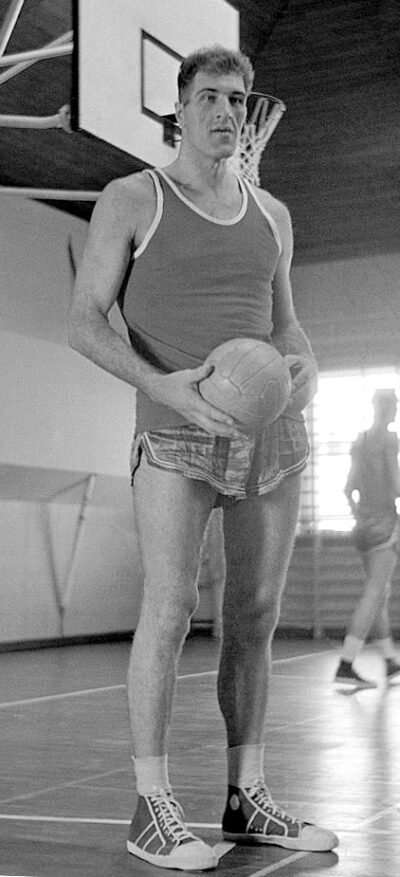
Jānis Krūmiņš
Jānis Krūmiņš was a Soviet basketball player. Born January 30, 1930, in Raiskums. Died November 20, 1994, in Riga. Teams include ASK Riga. Awards include Honoured Master of Sports of the USSR and Order of the Badge of Honour.
Facts
12 facts · 2 confirmed by two sources · 1 cited · 9 from one source
Where this comes from
Papalocal keeps its own record. It started from these sources; what each one said is kept here as it was copied, so a change on their side never changes this page by itself. Tap one to read its version.
What Wikidata says · copied November 17, 2026 · revision 2563455545
- Described as
- Soviet basketball player (1930-1994)
- Born
- January 30, 1930
- Died
- November 20, 1994
- Born in
- Raiskums
- Died in
- Riga
- Citizen of
- Soviet Union; Latvia
- Occupation
- basketball player · 1 reference
- Teams
- ASK Riga
- Sport
- basketball
- Awards
- Honoured Master of Sports of the USSR; Order of the Badge of Honour
- Height
- 2.20 m (7 ft 3 in)
- Wikipedias with a page
- 27
Wikidata item Q2566702 (wikidata.org/wiki/Q2566702), public domain (CC0). Copied November 17, 2026.
What Wikipedia says · copied November 17, 2026 · revision 1385731786
Jānis Krūmiņš (30 January 1930 – 20 November 1994) was a Soviet-Latvian professional basketball player. Helped by his height (about 220 cm, or 7'3"), he was the first giant center that dominated under European baskets, for years. As a player of the senior Soviet Union national basketball team, Krūmiņš won 3 gold medals at the 1959, 1961, and 1963 EuroBaskets, as well as 3 silver medals at the 1956, 1960, and 1964 Summer Olympic Games.
A Russian poll that was conducted in 2006, named Krūmiņš as the 3rd most popular Soviet men's basketball player of all time, after Arvydas Sabonis and Vladimir Tkachenko.
- Born, in its opening lines
- January 30, 1930
- Died, in its opening lines
- November 20, 1994
From the Wikipedia article “Jānis Krūmiņš” (en.wikipedia.org/wiki/Jānis_Krūmiņš), by its contributors, under CC BY-SA 4.0 (creativecommons.org/licenses/by-sa/4.0/). Copied November 17, 2026; not changed.
Confirmed Two sources agree. Cited One source, and it names where it got it. One source One source, without a reference of its own. Sources disagree The sources disagree. We show the best-supported value and keep theirs below.
